


Three Questions Bengali Meaning – Class 12 Semester 4 English Prose: লিও টলস্টয়ের (Leo Tolstoy) বিখ্যাত গল্প Three Questions-এর সহজ বাংলা অর্থ, গুরুত্বপূর্ণ শব্দার্থ এবং Textual Questions and Answers এই পোস্টে পাবে।
WBCHSE Class 12 Fourth Semester English পরীক্ষার প্রস্তুতির জন্য এখানে গল্পের প্রতিটি ইংরেজি বাক্যকে phrase ও clause অনুযায়ী ভাগ করে বাংলা অর্থ বোঝানো হয়েছে। পাশাপাশি রয়েছে প্রয়োজনীয় শব্দ ও phrase-এর অর্থ, গুরুত্বপূর্ণ পাঠ্যভিত্তিক প্রশ্নোত্তর এবং গল্পের মূল ভাব। এই গাইডের সাহায্যে শিক্ষার্থীরা গল্পটি সহজে বুঝতে পারবে এবং পরীক্ষায় নিজের ভাষায় উত্তর লেখার প্রস্তুতি নিতে পারবে।
👉 [Hawk Roosting Bengali Meaning and Explanation – Class 12]
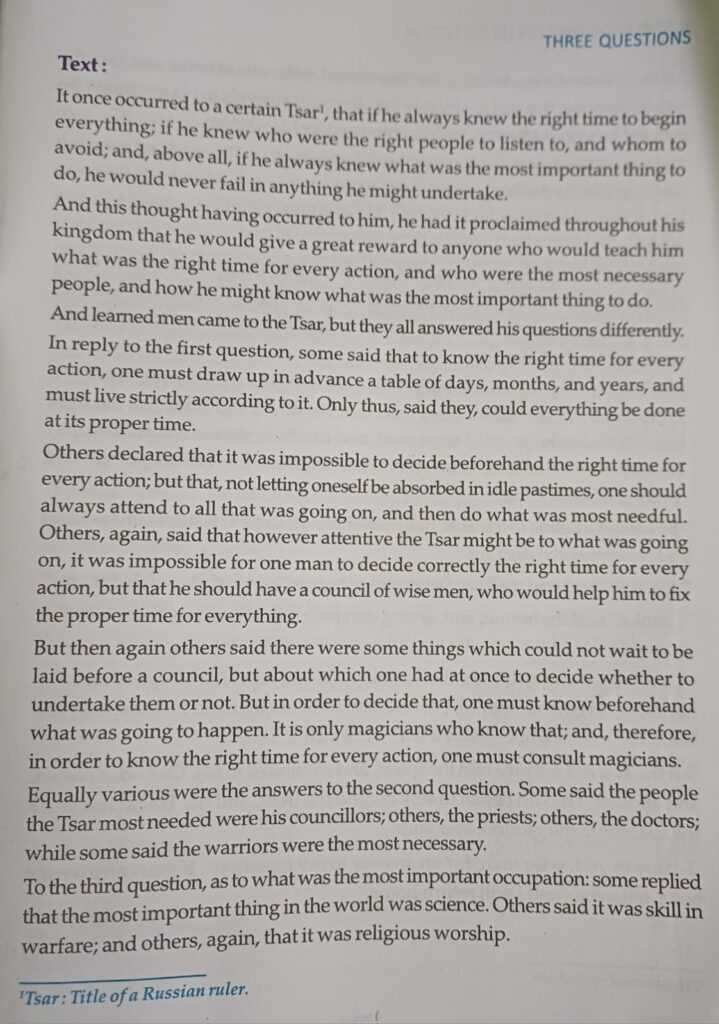
Three Questions —Text And Bengali Word meaning Of page 169
Bengali Word meaning
| English Word / Phrase | বাংলা অর্থ |
|---|---|
| Occurred to | মনে উদয় হওয়া |
| Certain | নির্দিষ্ট / কোনো এক |
| Tsar | রাশিয়ার সম্রাট |
| Right time | উপযুক্ত সময় |
| Undertake | হাতে নেওয়া / সম্পাদন করতে উদ্যোগী হওয়া |
| Avoid | এড়িয়ে চলা |
| Above all | সর্বোপরি |
| Proclaimed | ঘোষণা করেছিল |
| Kingdom | রাজ্য / সাম্রাজ্য |
| Reward | পুরস্কার |
| Action | কাজ / কার্য |
| Necessary | প্রয়োজনীয় |
| Learned men | বিদ্বান ব্যক্তিরা |
| Differently | ভিন্নভাবে |
| In reply to | উত্তরে |
| Draw up | তৈরি করা / প্রস্তুত করা |
| In advance | আগাম |
| Table | তালিকা / সময়সূচি |
| Strictly | কঠোরভাবে |
| According to | অনুসারে |
| Thus | এভাবে / এইভাবে |
| Proper | যথাযথ / উপযুক্ত |
| Impossible | অসম্ভব |
| Decide beforehand | আগেই সিদ্ধান্ত নেওয়া |
| Absorbed | সম্পূর্ণভাবে মগ্ন |
| Idle pastimes | অলস সময় কাটানোর কাজ |
| Attend to | মনোযোগ দেওয়া / খেয়াল রাখা |
| Going on | ঘটে চলেছে |
| Needful | প্রয়োজনীয় |
| Attentive | মনোযোগী |
| Council | পরিষদ |
| Wise men | জ্ঞানী ব্যক্তিরা |
| Fix | নির্ধারণ করা |
| Laid before | সামনে পেশ করা |
| At once | সঙ্গে সঙ্গে |
| Undertake them | সেগুলি হাতে নেওয়া |
| In order to | করার উদ্দেশ্যে |
| Happen | ঘটা |
| Magicians | জাদুকররা |
| Consult | পরামর্শ করা |
| Equally | সমানভাবে |
| Various | বিভিন্ন |
| Councillors | মন্ত্রীরা / উপদেষ্টারা |
| Priests | পুরোহিতরা |
| Warriors | যোদ্ধারা |
| Occupation | পেশা / কাজ |
| Replied | উত্তর দিয়েছিল |
| Science | বিজ্ঞান |
| Skill | দক্ষতা |
| Warfare | যুদ্ধবিদ্যা / যুদ্ধ |
| Religious worship | ধর্মীয় উপাসনা |
Phrase-wise Bengali Meaning
English Sentence 1
It once occurred to a certain Tsar, that if he always knew the right time to begin everything; if he knew who were the right people to listen to, and whom to avoid; and, above all, if he always knew what was the most important thing to do, he would never fail in anything he might undertake.
Phrase/Clause-wise Meaning:
- It once occurred to a certain Tsar — একবার এক রাজার মনে একটি কথা এসেছিল।
- that — যে
- if he always knew — যদি তিনি সর্বদা জানতেন
- the right time to begin everything — প্রতিটি কাজ শুরু করার সঠিক সময়
- if he knew — যদি তিনি জানতেন
- who were the right people to listen to — কোন ব্যক্তিদের কথা শোনা উচিত
- and whom to avoid — এবং কাদের এড়িয়ে চলা উচিত
- and, above all — এবং সর্বোপরি
- if he always knew — যদি তিনি সর্বদা জানতেন
- what was the most important thing to do — কোন কাজটি করা সবচেয়ে গুরুত্বপূর্ণ
- he would never fail — তিনি কখনো ব্যর্থ হতেন না
- in anything he might undertake — যে কাজই তিনি হাতে নিতেন, তাতে
ভাবার্থ: রাজা মনে করতেন, সব কাজের সঠিক সময়, উপযুক্ত ব্যক্তিদের এবং সবচেয়ে গুরুত্বপূর্ণ কাজটি চিনতে পারলে তিনি জীবনে কখনো ব্যর্থ হবেন না।
English Sentence 2
And this thought having occurred to him, he had it proclaimed throughout his kingdom that he would give a great reward to anyone who would teach him what was the right time for every action, and who were the most necessary people, and how he might know what was the most important thing to do.
Phrase/Clause-wise Meaning:
- And this thought having occurred to him — এই চিন্তাটি তাঁর মনে আসায়
- he had it proclaimed — তিনি তা ঘোষণা করালেন
- throughout his kingdom — তাঁর সমগ্র রাজ্যে
- that he would give a great reward — যে তিনি একটি বড় পুরস্কার দেবেন
- to anyone who would teach him — সেই ব্যক্তিকে, যিনি তাঁকে শেখাতে পারবেন
- what was the right time for every action — প্রতিটি কাজের উপযুক্ত সময় কী
- and who were the most necessary people — এবং কারা সবচেয়ে প্রয়োজনীয় ব্যক্তি
- and how he might know — এবং কীভাবে তিনি জানতে পারবেন
- what was the most important thing to do — কোন কাজটি করা সবচেয়ে গুরুত্বপূর্ণ
ভাবার্থ: রাজার তিনটি প্রশ্নের উত্তর দেওয়ার জন্য তিনি সমগ্র রাজ্যে ঘোষণা করালেন যে, যিনি তাঁকে এই বিষয়গুলি শেখাতে পারবেন, তাঁকে তিনি বড় পুরস্কার দেবেন।
English Sentence 3
And learned men came to the Tsar, but they all answered his questions differently.
Phrase/Clause-wise Meaning:
- And learned men came to the Tsar — আর পণ্ডিত ব্যক্তিরা রাজার কাছে এলেন।
- but — কিন্তু
- they all answered his questions differently — তাঁরা প্রত্যেকেই তাঁর প্রশ্নগুলির ভিন্ন ভিন্ন উত্তর দিলেন।
ভাবার্থ: অনেক জ্ঞানী ব্যক্তি রাজার প্রশ্নের উত্তর দিতে এলেও তাঁদের মতামত এক ছিল না।
2. The First Question: The Right Time
English Sentence 4
In reply to the first question, some said that to know the right time for every action, one must draw up in advance a table of days, months, and years, and must live strictly according to it.
Phrase/Clause-wise Meaning:
- In reply to the first question — প্রথম প্রশ্নের উত্তরে
- some said that — কেউ কেউ বললেন যে
- to know the right time for every action — প্রতিটি কাজের উপযুক্ত সময় জানতে
- one must draw up in advance — আগে থেকেই তৈরি করতে হবে
- a table of days, months, and years — দিন, মাস ও বছরের একটি তালিকা
- and must live strictly according to it — এবং কঠোরভাবে সেই তালিকা অনুসারে জীবনযাপন করতে হবে।
ভাবার্থ: কয়েকজন পণ্ডিতের মতে, প্রতিটি কাজের সঠিক সময় জানার জন্য আগে থেকেই দিন, মাস ও বছরের পরিকল্পনা তৈরি করে তা মেনে চলা উচিত।
English Sentence 5
Only thus, said they, could everything be done at its proper time.
Phrase/Clause-wise Meaning:
- Only thus — একমাত্র এভাবেই
- said they — তাঁরা বললেন
- could everything be done — সমস্ত কাজ করা সম্ভব
- at its proper time — তার উপযুক্ত সময়ে।
ভাবার্থ: তাঁদের বিশ্বাস ছিল, আগে থেকে তৈরি করা সময়সূচি মেনে চললেই প্রতিটি কাজ যথাসময়ে সম্পন্ন করা সম্ভব।
English Sentence 6
Others declared that it was impossible to decide beforehand the right time for every action;
Phrase/Clause-wise Meaning:
- Others declared that — অন্যরা ঘোষণা করলেন যে
- it was impossible — তা অসম্ভব ছিল
- to decide beforehand — আগে থেকেই নির্ধারণ করা
- the right time for every action — প্রতিটি কাজের সঠিক সময়।
ভাবার্থ: অন্য কয়েকজনের মতে, প্রতিটি কাজের উপযুক্ত সময় আগে থেকেই নির্দিষ্ট করে রাখা সম্ভব নয়।
English Sentence 7
but that, not letting oneself be absorbed in idle pastimes, one should always attend to all that was going on, and then do what was most needful.
Phrase/Clause-wise Meaning:
- but that — বরং তাঁরা বললেন যে
- not letting oneself be absorbed in idle pastimes — অনর্থক সময় কাটানোর কাজে নিজেকে ডুবিয়ে না রেখে
- one should always attend to — সবসময় মনোযোগ দেওয়া উচিত
- all that was going on — চারপাশে যা কিছু ঘটছিল, তার প্রতি
- and then do — এবং তারপর করা উচিত
- what was most needful — যা সবচেয়ে বেশি প্রয়োজনীয়।
ভাবার্থ: তাঁদের মতে, আগে থেকে সময় নির্ধারণ করার বদলে অলসতা এড়িয়ে বর্তমান পরিস্থিতির দিকে নজর দেওয়া এবং সেই মুহূর্তে সবচেয়ে প্রয়োজনীয় কাজটি করাই বুদ্ধিমানের কাজ।
3. The Advice of Other Learned Men
English Sentence 8
Others, again, said that however attentive the Tsar might be to what was going on, it was impossible for one man to decide correctly the right time for every action,
Phrase/Clause-wise Meaning:
- Others, again, said that — আবার অন্যরা বললেন যে
- however attentive the Tsar might be — রাজা যতই মনোযোগী হোন না কেন
- to what was going on — চারপাশে যা ঘটছিল, তার প্রতি
- it was impossible for one man — একজন মানুষের পক্ষে অসম্ভব ছিল
- to decide correctly — সঠিকভাবে নির্ধারণ করা
- the right time for every action — প্রতিটি কাজের উপযুক্ত সময়।
ভাবার্থ: তাঁদের মতে, রাজা যতই সতর্ক থাকুন না কেন, একা তাঁর পক্ষে সব কাজের সঠিক সময় নির্ধারণ করা সম্ভব নয়।
English Sentence 9
but that he should have a council of wise men, who would help him to fix the proper time for everything.
Phrase/Clause-wise Meaning:
- but that he should have — বরং তাঁর থাকা উচিত
- a council of wise men — জ্ঞানী ব্যক্তিদের একটি পরিষদ
- who would help him — যারা তাঁকে সাহায্য করবেন
- to fix the proper time for everything — প্রতিটি কাজের উপযুক্ত সময় নির্ধারণ করতে।
ভাবার্থ: তাই তাঁরা রাজাকে পরামর্শ দিলেন, যেন তিনি জ্ঞানী ব্যক্তিদের একটি পরিষদ গঠন করেন এবং তাঁদের সাহায্যে কাজের সঠিক সময় নির্ধারণ করেন।
4. The Advice of the Magicians
English Sentence 10
But then again others said there were some things which could not wait to be laid before a council, but about which one had at once to decide whether to undertake them or not.
Phrase/Clause-wise Meaning:
- But then again others said — কিন্তু আবার অন্যরা বললেন
- there were some things — এমন কিছু বিষয় ছিল
- which could not wait — যেগুলি অপেক্ষা করতে পারত না
- to be laid before a council — পরিষদের সামনে বিবেচনার জন্য উপস্থাপিত হওয়ার জন্য
- but about which — বরং সেই বিষয়গুলি সম্পর্কে
- one had at once to decide — সঙ্গে সঙ্গেই সিদ্ধান্ত নিতে হতো
- whether to undertake them or not — সেগুলি হাতে নেওয়া হবে কি হবে না।
ভাবার্থ: কিছু কাজ এতটাই জরুরি যে সেগুলির বিষয়ে পরিষদের পরামর্শ নেওয়ার জন্য অপেক্ষা করা যায় না। তাই দ্রুত সিদ্ধান্ত নেওয়া প্রয়োজন।
English Sentence 11
But in order to decide that, one must know beforehand what was going to happen.
Phrase/Clause-wise Meaning:
- But in order to decide that — কিন্তু সেই সিদ্ধান্ত নেওয়ার জন্য
- one must know beforehand — আগে থেকেই জানতে হবে
- what was going to happen — ভবিষ্যতে কী ঘটতে চলেছে।
ভাবার্থ: তাঁদের মতে, কোনো কাজ হাতে নেওয়া উচিত কি না, তা ঠিক করতে হলে ভবিষ্যতে কী ঘটবে, তা আগে থেকে জানা দরকার।
English Sentence 12
It is only magicians who know that; and, therefore, in order to know the right time for every action, one must consult magicians.
Phrase/Clause-wise Meaning:
- It is only magicians — একমাত্র জাদুকরেরাই
- who know that — তা জানেন
- and, therefore — এবং তাই
- in order to know the right time for every action — প্রতিটি কাজের সঠিক সময় জানতে
- one must consult magicians — জাদুকরদের পরামর্শ নিতে হবে।
ভাবার্থ: এই ব্যক্তিদের ধারণা ছিল, ভবিষ্যৎ কেবল জাদুকরেরাই জানতে পারেন। তাই কাজের সঠিক সময় জানতে তাঁদের সাহায্য নেওয়া উচিত।
5. The Second Question: The Most Necessary People
English Sentence 13
Equally various were the answers to the second question.
Phrase/Clause-wise Meaning:
- Equally various — একইভাবে বিভিন্ন রকমের
- were the answers — ছিল উত্তরগুলি
- to the second question — দ্বিতীয় প্রশ্নের।
ভাবার্থ: রাজার দ্বিতীয় প্রশ্নের উত্তর নিয়েও পণ্ডিতদের মধ্যে মতভেদ ছিল।
English Sentence 14
Some said the people the Tsar most needed were his councillors; others, the priests; others, the doctors; while some said the warriors were the most necessary.
Phrase/Clause-wise Meaning:
- Some said — কেউ কেউ বললেন
- the people the Tsar most needed — রাজা যাঁদের সবচেয়ে বেশি প্রয়োজন অনুভব করতেন
- were his councillors — তাঁরা ছিলেন তাঁর উপদেষ্টারা
- others, the priests — অন্যদের মতে, পুরোহিতেরা
- others, the doctors — আবার অন্যদের মতে, চিকিৎসকেরা
- while some said — অন্যদিকে কেউ কেউ বললেন
- the warriors were the most necessary — যোদ্ধারাই ছিলেন সবচেয়ে প্রয়োজনীয়।
ভাবার্থ: রাজার কাছে সবচেয়ে প্রয়োজনীয় ব্যক্তি কারা, তা নিয়ে বিভিন্ন মত ছিল। কেউ উপদেষ্টা, কেউ পুরোহিত, কেউ চিকিৎসক এবং কেউ যোদ্ধাদের সবচেয়ে গুরুত্বপূর্ণ বলে মনে করতেন।
6. The Third Question: The Most Important Occupation
English Sentence 15
To the third question, as to what was the most important occupation: some replied that the most important thing in the world was science.
Phrase/Clause-wise Meaning:
- To the third question — তৃতীয় প্রশ্নের উত্তরে
- as to what was the most important occupation — সবচেয়ে গুরুত্বপূর্ণ কাজ কোনটি, সে সম্পর্কে
- some replied that — কেউ কেউ উত্তর দিলেন যে
- the most important thing in the world — পৃথিবীর সবচেয়ে গুরুত্বপূর্ণ বিষয়
- was science — ছিল বিজ্ঞান।
ভাবার্থ: তৃতীয় প্রশ্নের উত্তরে কেউ কেউ বললেন, পৃথিবীর সবচেয়ে গুরুত্বপূর্ণ কাজ হলো বিজ্ঞানচর্চা।
English Sentence 16
Others said it was skill in warfare; and others, again, that it was religious worship.
Phrase/Clause-wise Meaning:
- Others said — অন্যরা বললেন
- it was skill in warfare — তা ছিল যুদ্ধবিদ্যায় দক্ষতা
- and others, again — আর অন্যদের মতে
- that it was religious worship — তা ছিল ধর্মীয় উপাসনা।
ভাবার্থ: অন্যদের মতে, যুদ্ধবিদ্যায় দক্ষতা অর্জন কিংবা ধর্মীয় উপাসনাই ছিল সবচেয়ে গুরুত্বপূর্ণ কাজ।
এই পৃষ্ঠার মূল কথা: রাজার তিনটি প্রশ্নের উত্তর নিয়ে পণ্ডিতদের মধ্যে ঐকমত্য ছিল না। প্রত্যেকে নিজের দৃষ্টিভঙ্গি অনুযায়ী উত্তর দিয়েছিলেন। এই মতভেদ থেকেই গল্পের পরবর্তী অংশে রাজার অনুসন্ধান আরও এগিয়ে যায়।
শব্দার্থের নোট: Tsar শব্দের অর্থ রাশিয়ার সম্রাট বা শাসক। Council অর্থ পরিষদ, councillors অর্থ উপদেষ্টা, warriors অর্থ যোদ্ধা এবং religious worship অর্থ ধর্মীয় উপাসনা।
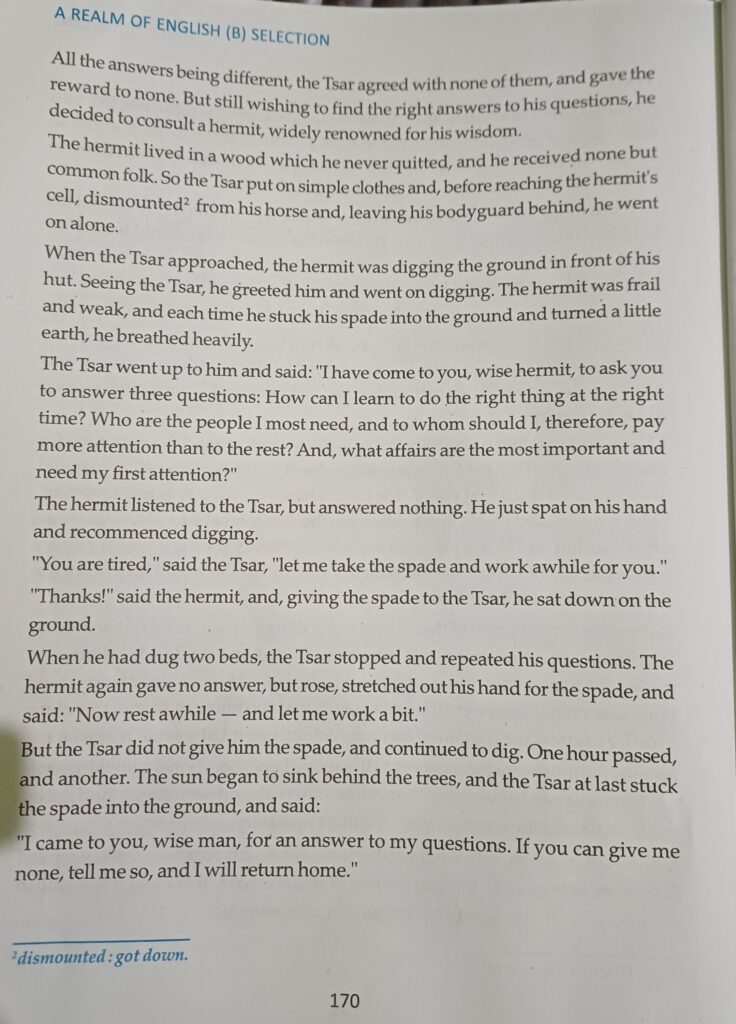
Three Questions by Leo Tolstoy Text And Bengali meaning page 170 class 12
Important Word Meanings
| English Word | বাংলা অর্থ |
|---|---|
| Agreed | সম্মত হয়েছিল |
| None | কেউই নয় / একটিও নয় |
| Reward | পুরস্কার |
| Wishing | ইচ্ছা করে / কামনা করে |
| Consult | পরামর্শ করা |
| Hermit | সন্ন্যাসী / নির্জনবাসী |
| Widely | ব্যাপকভাবে |
| Renowned | বিখ্যাত / প্রসিদ্ধ |
| Wisdom | জ্ঞান / প্রজ্ঞা |
| Wood | বন / জঙ্গল |
| Quit | ত্যাগ করা / ছেড়ে যাওয়া |
| Received | গ্রহণ করেছিল / দেখা করেছিল |
| Common folk | সাধারণ মানুষ |
| Simple | সাধারণ / সাদাসিধে |
| Clothes | পোশাক |
| Reaching | পৌঁছানো |
| Cell | ছোট কক্ষ / কুটির |
| Dismounted | ঘোড়া থেকে নামল |
| Bodyguard | দেহরক্ষী |
| Approached | কাছে এগিয়ে গেল |
| Hut | কুঁড়েঘর |
| Digging | খোঁড়াখুঁড়ি করা |
| Ground | মাটি |
| Greeted | অভ্যর্থনা জানাল |
| Frail | দুর্বল / ক্ষীণ |
| Spade | কোদাল |
| Turned | উল্টে দিল |
| Earth | মাটি |
| Breathed heavily | হাঁপাতে লাগল |
| Wise | জ্ঞানী |
| Attention | মনোযোগ |
| Affairs | বিষয়সমূহ / কাজকর্ম |
| Rest | বাকিরা / অবশিষ্ট |
| Spat | থুতু ফেলল |
| Recommenced | আবার শুরু করল |
| Tired | ক্লান্ত |
| Awhile | কিছুক্ষণ |
| Thanks | ধন্যবাদ |
| Stretched out | বাড়িয়ে দিল |
| Repeated | পুনরাবৃত্তি করল |
| Rose | উঠে দাঁড়াল |
| Continued | চালিয়ে গেল |
| Passed | অতিবাহিত হলো |
| Sink | অস্ত যাওয়া |
| At last | অবশেষে |
| Stuck | গেঁথে দিল |
| Return | ফিরে যাওয়া |
Phrase-wise Bengali Meaning
7. The Tsar Visits the Hermit
English Sentence 17
All the answers being different, the Tsar agreed with none of them, and gave the reward to none.
Phrase/Clause-wise Meaning:
- All the answers being different — সব উত্তর আলাদা হওয়ায়
- the Tsar agreed with none of them — রাজা সেগুলির একটিতেও সম্মত হলেন না
- and gave the reward to none — এবং কাউকেই পুরস্কার দিলেন না।
ভাবার্থ: পণ্ডিতদের উত্তরগুলি পরস্পরবিরোধী হওয়ায় রাজা কোনো উত্তরই গ্রহণ করলেন না এবং কাউকে পুরস্কৃত করলেন না।
English Sentence 18
But still wishing to find the right answers to his questions, he decided to consult a hermit, widely renowned for his wisdom.
Phrase/Clause-wise Meaning:
- But still wishing to find — কিন্তু তবুও খুঁজে পেতে চেয়ে
- the right answers to his questions — তাঁর প্রশ্নগুলির সঠিক উত্তর
- he decided to consult a hermit — তিনি এক সন্ন্যাসীর পরামর্শ নেওয়ার সিদ্ধান্ত নিলেন
- widely renowned for his wisdom — যিনি তাঁর জ্ঞানের জন্য বহুল পরিচিত ছিলেন।
ভাবার্থ: সঠিক উত্তর পাওয়ার আশা না ছেড়ে রাজা এক জ্ঞানী সন্ন্যাসীর কাছে যাওয়ার সিদ্ধান্ত নিলেন।
English Sentence 19
The hermit lived in a wood which he never quitted, and he received none but common folk.
Phrase/Clause-wise Meaning:
- The hermit lived in a wood — সন্ন্যাসী একটি বনে বাস করতেন
- which he never quitted — যে বন তিনি কখনো ছেড়ে যেতেন না
- and he received none but common folk — এবং তিনি সাধারণ মানুষ ছাড়া আর কাউকেই দেখা দিতেন না।
ভাবার্থ: সন্ন্যাসী নির্জন বনে বাস করতেন এবং কেবল সাধারণ মানুষদের সঙ্গেই দেখা করতেন।
English Sentence 20
So the Tsar put on simple clothes and, before reaching the hermit’s cell, dismounted from his horse and, leaving his bodyguard behind, he went on alone.
Phrase/Clause-wise Meaning:
- So the Tsar put on simple clothes — তাই রাজা সাধারণ পোশাক পরলেন
- before reaching the hermit’s cell — সন্ন্যাসীর কুটিরে পৌঁছানোর আগে
- dismounted from his horse — তিনি ঘোড়া থেকে নামলেন
- and, leaving his bodyguard behind — এবং নিজের দেহরক্ষীকে পিছনে রেখে
- he went on alone — তিনি একাই এগিয়ে গেলেন।
ভাবার্থ: সন্ন্যাসীর সঙ্গে দেখা করার জন্য রাজা সাধারণ মানুষের বেশ ধারণ করে একাই তাঁর কুটিরের দিকে গেলেন।
8. The Tsar Meets the Hermit
English Sentence 21
When the Tsar approached, the hermit was digging the ground in front of his hut.
Phrase/Clause-wise Meaning:
- When the Tsar approached — রাজা যখন কাছে এলেন
- the hermit was digging the ground — সন্ন্যাসী মাটি খুঁড়ছিলেন
- in front of his hut — তাঁর কুটিরের সামনে।
English Sentence 22
Seeing the Tsar, he greeted him and went on digging.
Phrase/Clause-wise Meaning:
- Seeing the Tsar — রাজাকে দেখে
- he greeted him — তিনি তাঁকে অভিবাদন জানালেন
- and went on digging — এবং মাটি খোঁড়া চালিয়ে গেলেন।
English Sentence 23
The hermit was frail and weak, and each time he stuck his spade into the ground and turned a little earth, he breathed heavily.
Phrase/Clause-wise Meaning:
- The hermit was frail and weak — সন্ন্যাসী ছিলেন দুর্বল ও ক্ষীণদেহী
- each time he stuck his spade into the ground — প্রতিবার তিনি কোদালটি মাটিতে বসাতেন
- and turned a little earth — এবং সামান্য মাটি উলটে দিতেন
- he breathed heavily — তিনি জোরে জোরে শ্বাস নিতেন।
ভাবার্থ: সন্ন্যাসী শারীরিকভাবে খুব দুর্বল ছিলেন। সামান্য মাটি খোঁড়ার পরও তাঁকে কষ্ট করে শ্বাস নিতে হচ্ছিল।
English Sentence 24
The Tsar went up to him and said: “I have come to you, wise hermit, to ask you to answer three questions:
Phrase/Clause-wise Meaning:
- The Tsar went up to him and said — রাজা তাঁর কাছে গিয়ে বললেন
- I have come to you — আমি আপনার কাছে এসেছি
- wise hermit — হে জ্ঞানী সন্ন্যাসী
- to ask you — আপনাকে অনুরোধ করতে
- to answer three questions — তিনটি প্রশ্নের উত্তর দেওয়ার জন্য।
English Sentence 25
How can I learn to do the right thing at the right time?
Phrase/Clause-wise Meaning:
- How can I learn — আমি কীভাবে শিখতে পারি
- to do the right thing — সঠিক কাজটি করতে
- at the right time — সঠিক সময়ে?
English Sentence 26
Who are the people I most need, and to whom should I, therefore, pay more attention than to the rest?
Phrase/Clause-wise Meaning:
- Who are the people — কারা সেই ব্যক্তি
- I most need — যাঁদের আমার সবচেয়ে বেশি প্রয়োজন
- and to whom should I, therefore, pay more attention — এবং তাই কাদের প্রতি আমার বেশি মনোযোগ দেওয়া উচিত
- than to the rest — অন্যদের তুলনায়?
English Sentence 27
And, what affairs are the most important and need my first attention?
Phrase/Clause-wise Meaning:
- And, what affairs are the most important — আর কোন বিষয়গুলি সবচেয়ে গুরুত্বপূর্ণ
- and need my first attention — এবং আমার প্রথম মনোযোগ দাবি করে?
ভাবার্থ (বাক্য ৮–১১): রাজা সন্ন্যাসীর কাছে তাঁর তিনটি প্রশ্নের উত্তর জানতে চাইলেন—সঠিক কাজের সঠিক সময় কীভাবে জানা যায়, কাদের গুরুত্ব দেওয়া উচিত এবং কোন কাজকে সবচেয়ে বেশি গুরুত্ব দিতে হয়।
9. The Tsar Helps the Hermit
English Sentence 28
The hermit listened to the Tsar, but answered nothing.
Phrase/Clause-wise Meaning:
- The hermit listened to the Tsar — সন্ন্যাসী রাজার কথা শুনলেন
- but answered nothing — কিন্তু কোনো উত্তর দিলেন না।
English Sentence 29
He just spat on his hand and recommenced digging.
Phrase/Clause-wise Meaning:
- He just spat on his hand — তিনি শুধু নিজের হাতে থুতু ফেললেন
- and recommenced digging — এবং আবার মাটি খোঁড়া শুরু করলেন।
English Sentence 30
“You are tired,” said the Tsar, “let me take the spade and work awhile for you.”
Phrase/Clause-wise Meaning:
- You are tired — আপনি ক্লান্ত
- said the Tsar — রাজা বললেন
- let me take the spade — আমাকে কোদালটি নিতে দিন
- and work awhile for you — এবং কিছুক্ষণ আপনার হয়ে কাজ করতে দিন।
English Sentence 31
“Thanks!” said the hermit, and, giving the spade to the Tsar, he sat down on the ground.
Phrase/Clause-wise Meaning:
- Thanks! said the hermit — “ধন্যবাদ!” সন্ন্যাসী বললেন
- and, giving the spade to the Tsar — এবং রাজাকে কোদালটি দিয়ে
- he sat down on the ground — তিনি মাটিতে বসে পড়লেন।
10. The Tsar Continues Digging
English Sentence 32
When he had dug two beds, the Tsar stopped and repeated his questions.
Phrase/Clause-wise Meaning:
- When he had dug two beds — তিনি যখন দুটি জমির বেড খুঁড়ে ফেললেন
- the Tsar stopped — রাজা থামলেন
- and repeated his questions — এবং আবার তাঁর প্রশ্নগুলি করলেন।
English Sentence 33
The hermit again gave no answer, but rose, stretched out his hand for the spade, and said: “Now rest awhile — and let me work a bit.”
Phrase/Clause-wise Meaning:
- The hermit again gave no answer — সন্ন্যাসী আবারও কোনো উত্তর দিলেন না
- but rose — বরং উঠে দাঁড়ালেন
- stretched out his hand for the spade — কোদালটি নেওয়ার জন্য হাত বাড়ালেন
- and said — এবং বললেন
- Now rest awhile — এবার কিছুক্ষণ বিশ্রাম নিন
- and let me work a bit — আর আমাকে একটু কাজ করতে দিন।
English Sentence 34
But the Tsar did not give him the spade, and continued to dig.
Phrase/Clause-wise Meaning:
- But the Tsar did not give him the spade — কিন্তু রাজা তাঁকে কোদালটি দিলেন না
- and continued to dig — এবং মাটি খুঁড়তে থাকলেন।
English Sentence 35
One hour passed, and another.
Phrase/Clause-wise Meaning:
- One hour passed — এক ঘণ্টা কেটে গেল
- and another — এবং আরও এক ঘণ্টা কেটে গেল।
English Sentence 36
The sun began to sink behind the trees, and the Tsar at last stuck the spade into the ground, and said:
Phrase/Clause-wise Meaning:
- The sun began to sink — সূর্য অস্ত যেতে শুরু করল
- behind the trees — গাছগুলির আড়ালে
- and the Tsar at last — এবং অবশেষে রাজা
- stuck the spade into the ground — কোদালটি মাটিতে গেঁথে দিলেন
- and said — এবং বললেন।
English Sentence 37
“I came to you, wise man, for an answer to my questions.
Phrase/Clause-wise Meaning:
- I came to you — আমি আপনার কাছে এসেছিলাম
- wise man — হে জ্ঞানী ব্যক্তি
- for an answer to my questions — আমার প্রশ্নগুলির উত্তর পাওয়ার জন্য।
English Sentence 38
If you can give me none, tell me so, and I will return home.
Phrase/Clause-wise Meaning:
- If you can give me none — যদি আপনি আমাকে কোনো উত্তর দিতে না পারেন
- tell me so — তাহলে তা আমাকে বলুন
- and I will return home — এবং আমি বাড়ি ফিরে যাব।
ভাবার্থ (এই অংশের সারমর্ম): রাজা সন্ন্যাসীর কাছ থেকে সরাসরি কোনো উত্তর পেলেন না। বরং তিনি নিজেই সন্ন্যাসীর কাজে সাহায্য করতে লাগলেন। সময় পেরিয়ে গেলেও সন্ন্যাসী নীরব থাকলেন। অবশেষে রাজা আবার উত্তর চাইলেন এবং উত্তর না পেলে ফিরে যাওয়ার কথা জানালেন।
এই পৃষ্ঠার গুরুত্বপূর্ণ শব্দগুলি: Hermit — সন্ন্যাসী, Wood — বন, Quitted — ত্যাগ করেছিলেন, Dismounted — ঘোড়া থেকে নামলেন, Bodyguard — দেহরক্ষী, Frail — ক্ষীণদেহী, Spade — কোদাল, Recommenced — পুনরায় শুরু করলেন, Affairs — বিষয় বা কাজ, Awhile — কিছুক্ষণ।
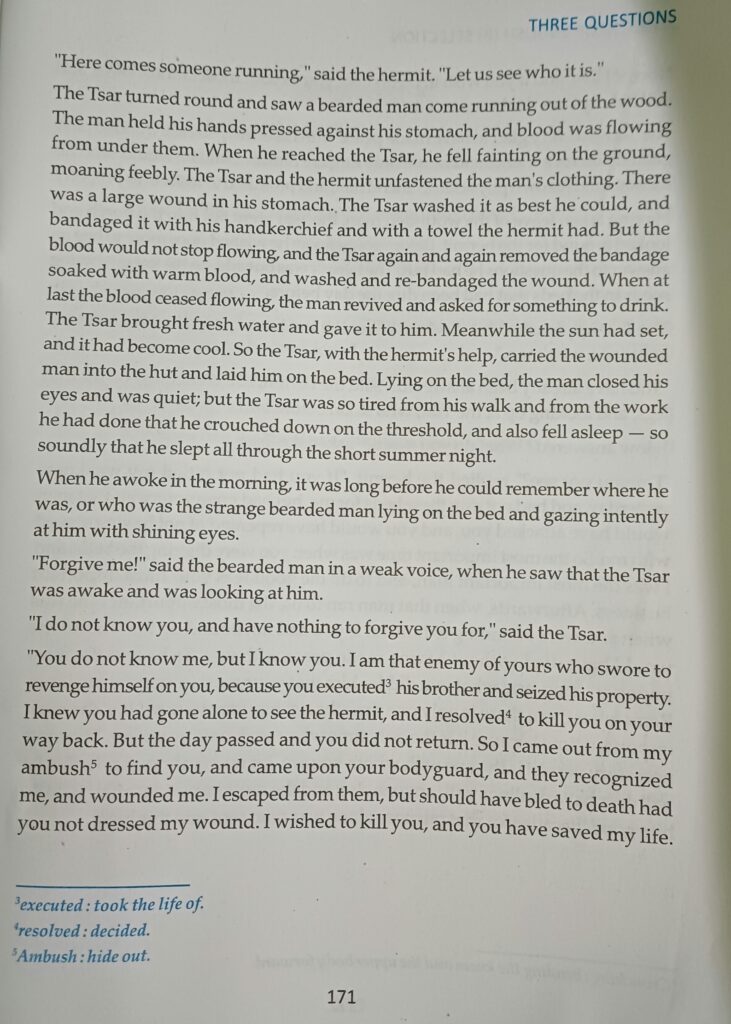
Three Questions Text And Bengali meaning page 171
Important Word Meanings
| English Word | বাংলা অর্থ |
|---|---|
| Running | দৌড়ে আসা |
| Bearded | দাড়িওয়ালা |
| Held | ধরে রেখেছিল |
| Pressed | চেপে ধরেছিল |
| Stomach | পেট |
| Blood | রক্ত |
| Flowing | প্রবাহিত হওয়া / বয়ে যাওয়া |
| Reached | পৌঁছাল |
| Fainting | অজ্ঞান হয়ে যাওয়া |
| Moaning | গোঙানো |
| Feebly | ক্ষীণভাবে / দুর্বলভাবে |
| Unfastened | খুলে দিল |
| Clothing | পোশাক |
| Wound | ক্ষত / আঘাত |
| Washed | ধুয়ে দিল |
| Bandaged | ব্যান্ডেজ বেঁধে দিল |
| Handkerchief | রুমাল |
| Towel | তোয়ালে |
| Removed | সরিয়ে ফেলল |
| Soaked | ভিজে যাওয়া |
| Re-bandaged | পুনরায় ব্যান্ডেজ বাঁধল |
| Ceased | বন্ধ হলো |
| Revived | জ্ঞান ফিরে পেল |
| Meanwhile | ইতিমধ্যে |
| Set | অস্ত গেল |
| Cool | ঠান্ডা |
| Carried | বহন করে নিয়ে গেল |
| Wounded | আহত |
| Hut | কুঁড়েঘর |
| Lying | শুয়ে থাকা |
| Quiet | শান্ত / নীরব |
| Crouched down | নিচু হয়ে বসে পড়ল |
| Threshold | দরজার চৌকাঠ |
| Soundly | গভীরভাবে |
| Awoke | ঘুম থেকে জেগে উঠল |
| Strange | অপরিচিত / অদ্ভুত |
| Gazing | একদৃষ্টিতে তাকিয়ে থাকা |
| Intently | গভীর মনোযোগ দিয়ে |
| Shining | উজ্জ্বল |
| Forgive | ক্ষমা করা |
| Weak | দুর্বল |
| Enemy | শত্রু |
| Swore | শপথ করেছিল |
| Revenge | প্রতিশোধ |
| Executed | মৃত্যুদণ্ড দিয়েছিল |
| Seized | দখল করেছিল |
| Property | সম্পত্তি |
| Resolved | সিদ্ধান্ত নিয়েছিল |
| Alone | একা |
| Ambush | অতর্কিত আক্রমণের জন্য লুকিয়ে থাকা জায়গা |
| Recognized | চিনতে পেরেছিল |
| Escaped | পালিয়ে গিয়েছিল |
| Bled | রক্তক্ষরণ হয়েছিল |
| Dressed (a wound) | ক্ষতস্থানে চিকিৎসা করা / ব্যান্ডেজ বাঁধা |
| Saved | বাঁচিয়েছিল |
Phrase-wise Bengali Meaning page 171
11. The Wounded Man Arrives
English Sentence 39
“Here comes someone running,” said the hermit. “Let us see who it is.”
Phrase/Clause-wise Meaning:
- Here comes someone running — এই যে কেউ একজন দৌড়ে আসছে।
- said the hermit — সন্ন্যাসী বললেন।
- Let us see — চলো, আমরা দেখি।
- who it is — সে কে।
English Sentence 40
The Tsar turned round and saw a bearded man come running out of the wood.
Phrase/Clause-wise Meaning:
- The Tsar turned round — রাজা ঘুরে দাঁড়ালেন।
- and saw a bearded man — এবং এক দাড়িওয়ালা লোককে দেখলেন।
- come running out of the wood — যে বন থেকে দৌড়ে বেরিয়ে আসছিল।
English Sentence 41
The man held his hands pressed against his stomach, and blood was flowing from under them.
Phrase/Clause-wise Meaning:
- The man held his hands pressed against his stomach — লোকটি তার পেটের ওপর দুই হাত চেপে ধরে রেখেছিল।
- and blood was flowing — এবং রক্ত বেরিয়ে আসছিল।
- from under them — হাত দুটির নিচ থেকে।
English Sentence 42
When he reached the Tsar, he fell fainting on the ground, moaning feebly.
Phrase/Clause-wise Meaning:
- When he reached the Tsar — যখন সে রাজার কাছে পৌঁছাল।
- he fell fainting on the ground — সে অজ্ঞান হয়ে মাটিতে পড়ে গেল।
- moaning feebly — দুর্বলভাবে গোঙাতে গোঙাতে।
English Sentence 43
The Tsar and the hermit unfastened the man’s clothing.
Phrase/Clause-wise Meaning:
- The Tsar and the hermit — রাজা ও সন্ন্যাসী।
- unfastened the man’s clothing — লোকটির পোশাক খুলে দিলেন।
English Sentence 44
There was a large wound in his stomach.
Phrase/Clause-wise Meaning:
- There was a large wound — একটি বড় ক্ষত ছিল।
- in his stomach — তার পেটে।
English Sentence 45
The Tsar washed it as best he could, and bandaged it with his handkerchief and with a towel the hermit had.
Phrase/Clause-wise Meaning:
- The Tsar washed it — রাজা ক্ষতটি ধুয়ে দিলেন।
- as best he could — যতটা ভালোভাবে তাঁর পক্ষে সম্ভব ছিল।
- and bandaged it — এবং ক্ষতটিতে ব্যান্ডেজ বাঁধলেন।
- with his handkerchief — নিজের রুমাল দিয়ে।
- and with a towel the hermit had — এবং সন্ন্যাসীর কাছে থাকা একটি তোয়ালে দিয়ে।
ভাবার্থ: আহত লোকটির পেটে বড় ক্ষত ছিল। রাজা নিজে যথাসাধ্য ক্ষতটি পরিষ্কার করে রুমাল ও তোয়ালে দিয়ে বেঁধে দিলেন।
English Sentence 46
But the blood would not stop flowing, and the Tsar again and again removed the bandage soaked with warm blood, and washed and re-bandaged the wound.
Phrase/Clause-wise Meaning:
- But the blood would not stop flowing — কিন্তু রক্তপাত বন্ধ হচ্ছিল না।
- and the Tsar again and again removed the bandage — আর রাজা বারবার ব্যান্ডেজ খুলে ফেললেন।
- soaked with warm blood — যা উষ্ণ রক্তে ভিজে গিয়েছিল।
- and washed — এবং ক্ষতটি ধুয়ে দিলেন।
- and re-bandaged the wound — আবার ক্ষতটিতে ব্যান্ডেজ বেঁধে দিলেন।
English Sentence 47
When at last the blood ceased flowing, the man revived and asked for something to drink.
Phrase/Clause-wise Meaning:
- When at last the blood ceased flowing — অবশেষে যখন রক্তপাত বন্ধ হলো।
- the man revived — লোকটি জ্ঞান ফিরে পেল।
- and asked for something to drink — এবং পান করার জন্য কিছু চাইল।
English Sentence 48
The Tsar brought fresh water and gave it to him.
Phrase/Clause-wise Meaning:
- The Tsar brought fresh water — রাজা পরিষ্কার জল নিয়ে এলেন।
- and gave it to him — এবং তাকে তা পান করতে দিলেন।
English Sentence 49
Meanwhile the sun had set, and it had become cool.
Phrase/Clause-wise Meaning:
- Meanwhile — এদিকে / ইতিমধ্যে।
- the sun had set — সূর্য অস্ত গিয়েছিল।
- and it had become cool — এবং আবহাওয়া ঠান্ডা হয়ে গিয়েছিল।
English Sentence 50
So the Tsar, with the hermit’s help, carried the wounded man into the hut and laid him on the bed.
Phrase/Clause-wise Meaning:
- So the Tsar — তাই রাজা।
- with the hermit’s help — সন্ন্যাসীর সাহায্যে।
- carried the wounded man into the hut — আহত লোকটিকে কুটিরের ভিতরে নিয়ে গেলেন।
- and laid him on the bed — এবং তাকে বিছানায় শুইয়ে দিলেন।
English Sentence 51
Lying on the bed, the man closed his eyes and was quiet; but the Tsar was so tired from his walk and from the work he had done that he crouched down on the threshold, and also fell asleep — so soundly that he slept all through the short summer night.
Phrase/Clause-wise Meaning:
- Lying on the bed — বিছানায় শুয়ে।
- the man closed his eyes — লোকটি চোখ বন্ধ করল।
- and was quiet — এবং চুপ করে রইল।
- but the Tsar was so tired — কিন্তু রাজা এতটাই ক্লান্ত ছিলেন।
- from his walk — তাঁর হাঁটাচলার কারণে।
- and from the work he had done — এবং তাঁর করা কাজের কারণে।
- that he crouched down on the threshold — যে তিনি দরজার চৌকাঠের কাছে গুটিসুটি হয়ে বসে পড়লেন।
- and also fell asleep — এবং তিনিও ঘুমিয়ে পড়লেন।
- so soundly that — এত গভীরভাবে যে।
- he slept all through the short summer night — গ্রীষ্মের ছোট রাতটি তিনি সম্পূর্ণ ঘুমিয়ে কাটালেন।
ভাবার্থ: রাজা নিজের ক্লান্তির কথা না ভেবে আহত লোকটির সেবা করেছিলেন। পরে ক্লান্তিতে তিনি কুটিরের দরজার কাছেই ঘুমিয়ে পড়েন।
12. The Wounded Man Asks for Forgiveness
English Sentence 52
When he awoke in the morning, it was long before he could remember where he was, or who was the strange bearded man lying on the bed and gazing intently at him with shining eyes.
Phrase/Clause-wise Meaning:
- When he awoke in the morning — সকালে যখন তিনি জেগে উঠলেন।
- it was long before — বেশ কিছু সময় লেগেছিল।
- he could remember — তাঁর মনে করতে।
- where he was — তিনি কোথায় ছিলেন।
- or who was the strange bearded man — অথবা সেই অচেনা দাড়িওয়ালা লোকটি কে ছিল।
- lying on the bed — যে বিছানায় শুয়ে ছিল।
- and gazing intently at him — এবং তাঁর দিকে একদৃষ্টে তাকিয়ে ছিল।
- with shining eyes — উজ্জ্বল চোখে।
English Sentence 53
“Forgive me!” said the bearded man in a weak voice, when he saw that the Tsar was awake and was looking at him.
Phrase/Clause-wise Meaning:
- Forgive me! — আমাকে ক্ষমা করুন!
- said the bearded man — দাড়িওয়ালা লোকটি বলল।
- in a weak voice — দুর্বল কণ্ঠে।
- when he saw — যখন সে দেখল।
- that the Tsar was awake — যে রাজা জেগে উঠেছেন।
- and was looking at him — এবং তাঁর দিকে তাকিয়ে আছেন।
English Sentence 54
“I do not know you, and have nothing to forgive you for,” said the Tsar.
Phrase/Clause-wise Meaning:
- I do not know you — আমি তোমাকে চিনি না।
- and have nothing to forgive you for — আর তোমাকে ক্ষমা করার মতো কোনো কারণও আমার নেই।
- said the Tsar — রাজা বললেন।
English Sentence 55
“You do not know me but I know you.
Phrase/Clause-wise Meaning:
- You do not know me — আপনি আমাকে চেনেন না।
- but I know you — কিন্তু আমি আপনাকে চিনি।
English Sentence 56
I am that enemy of yours who swore to revenge himself on you, because you executed his brother and seized his property.
Phrase/Clause-wise Meaning:
- I am that enemy of yours — আমি আপনার সেই শত্রু।
- who swore — যে শপথ করেছিল।
- to revenge himself on you — আপনার ওপর প্রতিশোধ নেওয়ার।
- because you executed his brother — কারণ আপনি তার ভাইকে মৃত্যুদণ্ড দিয়েছিলেন।
- and seized his property — এবং তার সম্পত্তি কেড়ে নিয়েছিলেন।
English Sentence 57
I knew you had gone alone to see the hermit, and I resolved to kill you on your way back.
Phrase/Clause-wise Meaning:
- I knew — আমি জানতাম।
- you had gone alone — আপনি একা গিয়েছিলেন।
- to see the hermit — সন্ন্যাসীর সঙ্গে দেখা করতে।
- and I resolved — এবং আমি সিদ্ধান্ত নিয়েছিলাম।
- to kill you — আপনাকে হত্যা করার।
- on your way back — ফেরার পথে।
English Sentence 58
But the day passed and you did not return.
Phrase/Clause-wise Meaning:
- But the day passed — কিন্তু দিন কেটে গেল।
- and you did not return — আর আপনি ফিরে এলেন না।
English Sentence 59
So I came out from my ambush to find you, and came upon your bodyguard, and they recognized me, and wounded me.
Phrase/Clause-wise Meaning:
- So I came out from my ambush — তাই আমি আমার লুকিয়ে থাকার জায়গা থেকে বেরিয়ে এলাম।
- to find you — আপনাকে খুঁজে বের করার জন্য।
- and came upon your bodyguard — এবং আপনার দেহরক্ষীদের সামনে পড়লাম।
- and they recognized me — তারা আমাকে চিনে ফেলল।
- and wounded me — এবং আমাকে আহত করল।
English Sentence 60
I escaped from them, but should have bled to death had you not dressed my wound.
Phrase/Clause-wise Meaning:
- I escaped from them — আমি তাদের হাত থেকে পালিয়ে এসেছিলাম।
- but should have bled to death — কিন্তু রক্তক্ষরণে আমার মৃত্যু হতো।
- had you not dressed my wound — যদি আপনি আমার ক্ষত বেঁধে না দিতেন।
English Sentence 61
I wished to kill you, and you have saved my life.
Phrase/Clause-wise Meaning:
- I wished to kill you — আমি আপনাকে হত্যা করতে চেয়েছিলাম।
- and you have saved my life — অথচ আপনি আমার জীবন বাঁচিয়েছেন।
ভাবার্থ (এই অংশের সারমর্ম): রাজা তাঁর শত্রুকে চিনতে না পারলেও তাকে বাঁচানোর জন্য যথাসাধ্য চেষ্টা করেন। সেই শত্রুই পরে স্বীকার করে যে, সে রাজাকে হত্যা করতে এসেছিল। কিন্তু রাজার দয়া ও সেবার কারণে তার মন পরিবর্তিত হয় এবং সে রাজার কাছে ক্ষমা চায়।
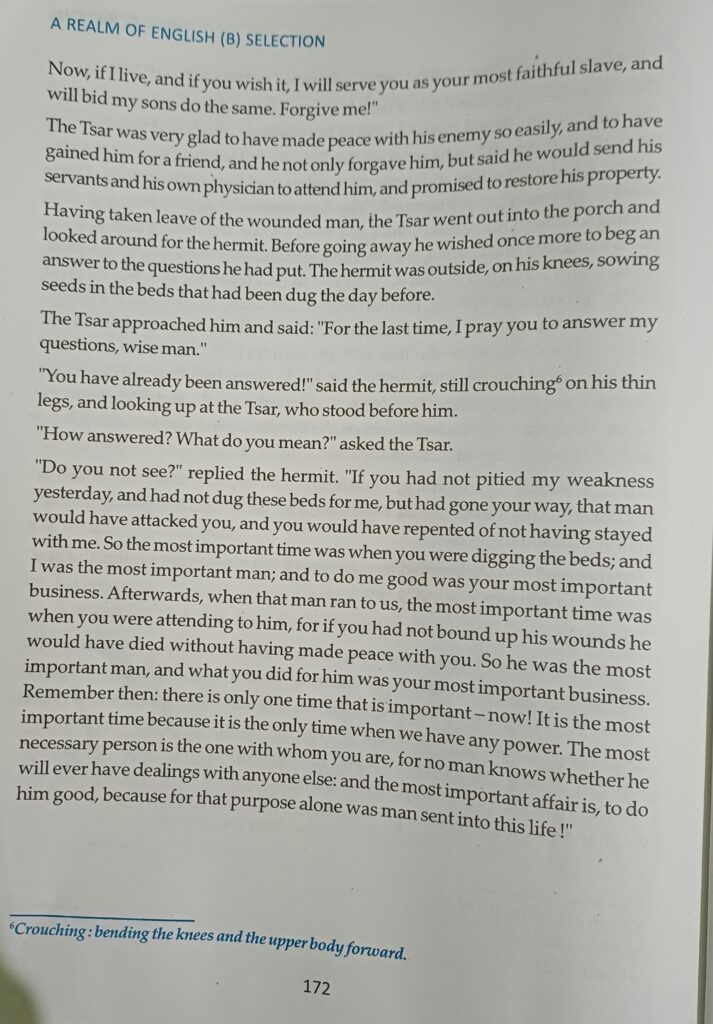
Three Questions Text And Bengali meaning page 172
গুরুত্বপূর্ণ শব্দার্থ page 172
| English Word | বাংলা অর্থ |
|---|---|
| Faithful | বিশ্বস্ত / অনুগত |
| Slave | দাস / ভৃত্য |
| Bid | আদেশ করা |
| Forgive | ক্ষমা করা |
| Glad | আনন্দিত / খুশি |
| Made peace | শান্তি স্থাপন করেছিল / মিটমাট করেছিল |
| Enemy | শত্রু |
| Easily | সহজেই |
| Gained | অর্জন করেছিল / লাভ করেছিল |
| Friend | বন্ধু |
| Forgave | ক্ষমা করেছিল |
| Servants | ভৃত্য / চাকর |
| Physician | চিকিৎসক |
| Attend | চিকিৎসা করা / সেবা করা |
| Promised | প্রতিশ্রুতি দিয়েছিল |
| Restore | ফিরিয়ে দেওয়া / পুনরুদ্ধার করা |
| Property | সম্পত্তি |
| Having taken leave | বিদায় নিয়ে |
| Wounded | আহত |
| Porch | বারান্দা |
| Looked around | চারদিকে তাকাল |
| Hermit | সন্ন্যাসী |
| Beg | অনুরোধ করা / প্রার্থনা করা |
| Answer | উত্তর |
| Approached | কাছে এগিয়ে গেল |
| Pray | অনুরোধ করা / প্রার্থনা করা |
| Already | ইতিমধ্যে |
| Answered | উত্তর দেওয়া হয়েছে |
| Crouching | হাঁটু ভাঁজ করে নিচু হয়ে বসা |
| Thin | সরু / রোগা |
| Replied | উত্তর দিল |
| Pitied | করুণা করেছিল |
| Weakness | দুর্বলতা |
| Yesterday | গতকাল |
| Attacked | আক্রমণ করেছিল |
| Repented | অনুতপ্ত হয়েছিল |
| Afterwards | পরবর্তীকালে / তারপর |
| Attending | সেবা করা / দেখাশোনা করা |
| Bound up | বেঁধে দেওয়া / ব্যান্ডেজ করা |
| Remember | মনে রাখা |
| Power | ক্ষমতা |
| Necessary | প্রয়োজনীয় |
| Deals (with) | সম্পর্ক রাখে / লেনদেন করে |
| Whether | কিনা |
| Affair | বিষয় / কাজ |
| Purpose | উদ্দেশ্য |
| Alone | একমাত্র / শুধু |
| Sent | পাঠানো হয়েছিল |
Phrase-wise Bengali Meaning page 172
13. The Wounded Man Promises Loyalty
English Sentence 62
Now, if I live, and if you wish it, I will serve you as your most faithful slave, and will bid my sons do the same. Forgive me!
Phrase/Clause-wise Meaning:
- Now, if I live — এখন, যদি আমি বেঁচে থাকি
- and if you wish it — এবং আপনি যদি তা চান
- I will serve you — আমি আপনার সেবা করব
- as your most faithful slave — আপনার সবচেয়ে বিশ্বস্ত দাস হিসেবে
- and will bid my sons do the same — এবং আমার ছেলেদেরও একই কাজ করতে বলব
- Forgive me! — আমাকে ক্ষমা করুন!
ভাবার্থ: আহত লোকটি রাজাকে প্রতিশ্রুতি দিল যে, বেঁচে থাকলে সে এবং তার ছেলেরা রাজার বিশ্বস্ত সেবক হয়ে থাকবে। সে নিজের অপরাধের জন্য ক্ষমাও চাইল।
English Sentence 63
The Tsar was very glad to have made peace with his enemy so easily, and to have gained him for a friend, and he not only forgave him, but said he would send his servants and his own physician to attend him, and promised to restore his property.
Phrase/Clause-wise Meaning:
- The Tsar was very glad — রাজা খুব আনন্দিত হলেন
- to have made peace with his enemy so easily — এত সহজে নিজের শত্রুর সঙ্গে শান্তি স্থাপন করতে পেরে
- and to have gained him for a friend — এবং তাকে বন্ধু হিসেবে পেয়ে
- and he not only forgave him — তিনি শুধু তাকে ক্ষমাই করলেন না
- but said — বরং বললেন
- he would send his servants — তিনি তাঁর কর্মচারীদের পাঠাবেন
- and his own physician — এবং তাঁর নিজের চিকিৎসককেও
- to attend him — তার চিকিৎসা ও সেবার জন্য
- and promised to restore his property — এবং তার সম্পত্তি ফিরিয়ে দেওয়ার প্রতিশ্রুতি দিলেন।
ভাবার্থ: রাজা শত্রুর সঙ্গে বন্ধুত্ব স্থাপন করতে পেরে খুশি হলেন। তিনি তাকে ক্ষমা করলেন, চিকিৎসার ব্যবস্থা করলেন এবং তার সম্পত্তি ফিরিয়ে দেওয়ার প্রতিশ্রুতি দিলেন।
14. The Tsar Asks the Hermit Again
English Sentence 64
Having taken leave of the wounded man, the Tsar went out into the porch and looked around for the hermit.
Phrase/Clause-wise Meaning:
- Having taken leave of the wounded man — আহত লোকটির কাছ থেকে বিদায় নিয়ে
- the Tsar went out into the porch — রাজা বারান্দায় বেরিয়ে গেলেন
- and looked around for the hermit — এবং সন্ন্যাসীকে চারদিকে খুঁজতে লাগলেন।
English Sentence 65
Before going away he wished once more to beg an answer to the questions he had put.
Phrase/Clause-wise Meaning:
- Before going away — চলে যাওয়ার আগে
- he wished once more — তিনি আরও একবার চাইলেন
- to beg an answer — একটি উত্তর প্রার্থনা করতে
- to the questions he had put — তাঁর করা প্রশ্নগুলির।
English Sentence 66
The hermit was outside, on his knees, sowing seeds in the beds that had been dug the day before.
Phrase/Clause-wise Meaning:
- The hermit was outside — সন্ন্যাসী বাইরে ছিলেন
- on his knees — হাঁটু গেড়ে
- sowing seeds — বীজ বপন করছিলেন
- in the beds — জমির তৈরি বেডগুলিতে
- that had been dug the day before — যেগুলি আগের দিন খোঁড়া হয়েছিল।
English Sentence 67
The Tsar approached him and said: “For the last time, I pray you to answer my questions, wise man.”
Phrase/Clause-wise Meaning:
- The Tsar approached him — রাজা তাঁর কাছে এগিয়ে গেলেন
- and said — এবং বললেন
- For the last time — শেষবারের মতো
- I pray you — আমি আপনাকে অনুরোধ করছি
- to answer my questions — আমার প্রশ্নগুলির উত্তর দিতে
- wise man — হে জ্ঞানী ব্যক্তি।
English Sentence 68
“You have already been answered!” said the hermit, still crouching on his thin legs, and looking up at the Tsar, who stood before him.
Phrase/Clause-wise Meaning:
- You have already been answered! — আপনি ইতিমধ্যেই আপনার প্রশ্নগুলির উত্তর পেয়ে গেছেন!
- said the hermit — সন্ন্যাসী বললেন
- still crouching on his thin legs — তখনও তাঁর সরু পায়ে ভর দিয়ে উবু হয়ে বসে
- and looking up at the Tsar — এবং রাজার দিকে মুখ তুলে তাকিয়ে
- who stood before him — যিনি তাঁর সামনে দাঁড়িয়েছিলেন।
English Sentence 69
“How answered? What do you mean?” asked the Tsar.
Phrase/Clause-wise Meaning:
- How answered? — কীভাবে উত্তর পেয়েছি?
- What do you mean? — আপনি কী বলতে চাইছেন?
- asked the Tsar — রাজা জিজ্ঞাসা করলেন।
15. The Hermit Explains the First Answer
English Sentence 70
“Do you not see?” replied the hermit.
Phrase/Clause-wise Meaning:
- Do you not see? — আপনি কি বুঝতে পারছেন না?
- replied the hermit — সন্ন্যাসী উত্তর দিলেন।
English Sentence 71
“If you had not pitied my weakness yesterday, and had not dug these beds for me, but had gone your way, that man would have attacked you, and you would have repented of not having stayed with me.”
Phrase/Clause-wise Meaning:
- If you had not pitied my weakness yesterday — গতকাল আপনি যদি আমার দুর্বলতার প্রতি দয়া না দেখাতেন
- and had not dug these beds for me — এবং আমার জন্য এই জমিগুলি খুঁড়ে না দিতেন
- but had gone your way — বরং নিজের পথে চলে যেতেন
- that man would have attacked you — সেই লোকটি আপনাকে আক্রমণ করত
- and you would have repented — এবং আপনি অনুতপ্ত হতেন
- of not having stayed with me — আমার সঙ্গে থেকে না যাওয়ার জন্য।
ভাবার্থ: রাজা যদি সন্ন্যাসীর দুর্বলতা দেখে তাঁকে সাহায্য না করতেন, তাহলে আহত লোকটি রাজাকে আক্রমণ করতে পারত। ফলে সন্ন্যাসীর সঙ্গে থেকে তাঁকে সাহায্য না করার জন্য রাজাকে অনুতপ্ত হতে হতো।
English Sentence 72
So the most important time was when you were digging the beds; and I was the most important man; and to do me good was your most important business.
Phrase/Clause-wise Meaning:
- So the most important time was — তাই সবচেয়ে গুরুত্বপূর্ণ সময় ছিল
- when you were digging the beds — যখন আপনি জমির বেডগুলি খুঁড়ছিলেন
- and I was the most important man — এবং আমিই ছিলাম সবচেয়ে গুরুত্বপূর্ণ ব্যক্তি
- and to do me good — আর আমার উপকার করা
- was your most important business — ছিল আপনার সবচেয়ে গুরুত্বপূর্ণ কাজ।
ভাবার্থ: সন্ন্যাসীর মতে, রাজা যখন তাঁকে সাহায্য করছিলেন, তখন সেই মুহূর্তটিই ছিল সবচেয়ে গুরুত্বপূর্ণ। তখন সন্ন্যাসীই ছিলেন রাজার কাছে সবচেয়ে গুরুত্বপূর্ণ ব্যক্তি, আর তাঁকে সাহায্য করাই ছিল রাজার প্রধান কর্তব্য।
16. The Hermit Explains the Second Incident
English Sentence 73
Afterwards, when that man ran to us, the most important time was when you were attending to him, for if you had not bound up his wounds he would have died without having made peace with you.
Phrase/Clause-wise Meaning:
- Afterwards — পরে
- when that man ran to us — যখন সেই লোকটি আমাদের কাছে দৌড়ে এসেছিল
- the most important time was — সবচেয়ে গুরুত্বপূর্ণ সময় ছিল
- when you were attending to him — যখন আপনি তার সেবা করছিলেন
- for if you had not bound up his wounds — কারণ আপনি যদি তার ক্ষতগুলি বেঁধে না দিতেন
- he would have died — তবে সে মারা যেত
- without having made peace with you — আপনার সঙ্গে শান্তি স্থাপন না করেই।
ভাবার্থ: আহত লোকটির চিকিৎসা করার সময়টিই ছিল সবচেয়ে গুরুত্বপূর্ণ। রাজা তাকে বাঁচিয়ে তোলায় সে নিজের ভুল স্বীকার করার এবং রাজার সঙ্গে শান্তি স্থাপন করার সুযোগ পেয়েছিল।
English Sentence 74
So he was the most important man, and what you did for him was your most important business.
Phrase/Clause-wise Meaning:
- So he was the most important man — তাই সেই লোকটিই ছিল সবচেয়ে গুরুত্বপূর্ণ ব্যক্তি
- and what you did for him — এবং আপনি তার জন্য যা করেছিলেন
- was your most important business — সেটিই ছিল আপনার সবচেয়ে গুরুত্বপূর্ণ কাজ।
17. The Three Answers of the Hermit
English Sentence 75
Remember then: there is only one time that is important — now!
Phrase/Clause-wise Meaning:
- Remember then — তাহলে মনে রাখুন
- there is only one time — একটিমাত্র সময়ই রয়েছে
- that is important — যা গুরুত্বপূর্ণ
- now! — তা হলো বর্তমান মুহূর্ত!
English Sentence 76
It is the most important time because it is the only time when we have any power.
Phrase/Clause-wise Meaning:
- It is the most important time — এটিই সবচেয়ে গুরুত্বপূর্ণ সময়
- because — কারণ
- it is the only time — এটিই একমাত্র সময়
- when we have any power — যখন আমাদের হাতে কাজ করার ক্ষমতা থাকে।
ভাবার্থ: অতীত চলে গেছে এবং ভবিষ্যৎ এখনও আসেনি। তাই বর্তমানে যে সময়টি আমাদের হাতে রয়েছে, সেটিই কাজ করার প্রকৃত সুযোগ।
English Sentence 77
The most necessary person is the one with whom you are, for no man knows whether he will ever have dealings with anyone else;
Phrase/Clause-wise Meaning:
- The most necessary person — সবচেয়ে প্রয়োজনীয় ব্যক্তি
- is the one — হলেন সেই ব্যক্তি
- with whom you are — যাঁর সঙ্গে আপনি বর্তমানে আছেন
- for no man knows — কারণ কেউ জানে না
- whether he will ever have dealings — তার কখনও যোগাযোগ বা লেনদেন হবে কি না
- with anyone else — অন্য কারও সঙ্গে।
ভাবার্থ: যে ব্যক্তি এই মুহূর্তে আপনার সামনে আছেন, তাঁর প্রতিই আপনার মনোযোগ দেওয়া উচিত। ভবিষ্যতে অন্য কারও সঙ্গে আপনার যোগাযোগ হবে কি না, তা কেউ জানে না।
English Sentence 78
And the most important affair is, to do him good, because for that purpose alone was man sent into this life!
Phrase/Clause-wise Meaning:
- And the most important affair is — আর সবচেয়ে গুরুত্বপূর্ণ কাজ হলো
- to do him good — সেই ব্যক্তির উপকার করা
- because — কারণ
- for that purpose alone — একমাত্র সেই উদ্দেশ্যেই
- was man sent into this life — মানুষকে এই পৃথিবীতে পাঠানো হয়েছে।
ভাবার্থ: সন্ন্যাসীর মতে, মানুষের জীবনের প্রধান উদ্দেশ্য হলো অন্যের উপকার করা। বর্তমান মুহূর্তে যে মানুষটির সঙ্গে আমাদের দেখা হয়, তার প্রতি সদয় হওয়া এবং তার সাহায্যে এগিয়ে আসাই সবচেয়ে গুরুত্বপূর্ণ কাজ।
গল্পের শেষ অংশের মূল শিক্ষা
সন্ন্যাসী রাজার তিনটি প্রশ্নের উত্তর দিলেন:
- সঠিক সময়: বর্তমান মুহূর্তই সবচেয়ে গুরুত্বপূর্ণ।
- সবচেয়ে প্রয়োজনীয় ব্যক্তি: যে ব্যক্তি এই মুহূর্তে আপনার সঙ্গে রয়েছে।
- সবচেয়ে গুরুত্বপূর্ণ কাজ: সেই ব্যক্তির উপকার করা।
এই তিনটি শিক্ষা গল্পের মূল বার্তা—অতীত বা ভবিষ্যৎ নিয়ে অতিরিক্ত চিন্তা না করে বর্তমানের সুযোগকে কাজে লাগানো এবং মানুষের প্রতি সদয় হওয়া।
Three Questions — Textual Questions and Answers
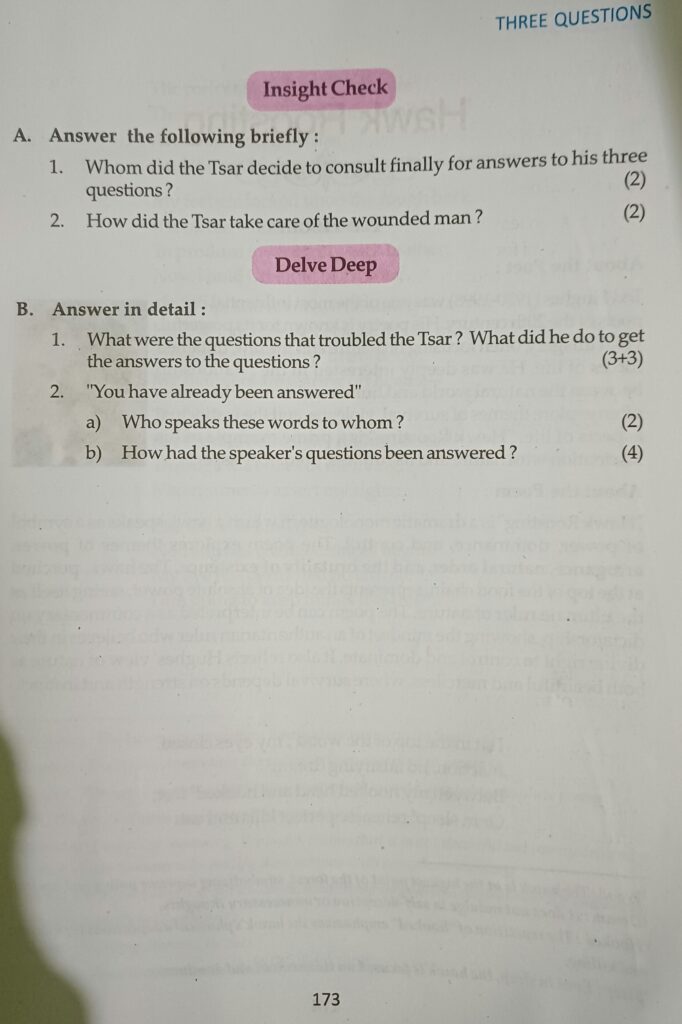
A. Answer the following briefly
1. Whom did the Tsar decide to consult finally for answers to his three questions? (2 marks)
Answer: The Tsar finally decided to consult a hermit who was widely renowned for his wisdom. The hermit lived in a wood and received only common people.
2. How did the Tsar take care of the wounded man? (2 marks)
Answer: The Tsar washed the wounded man’s wound and bandaged it with his handkerchief and a towel. He repeatedly washed and re-bandaged the wound until the bleeding stopped. He also gave the man water and, with the hermit’s help, carried him into the hut and laid him on a bed.
B. Answer in detail
1. What were the questions that troubled the Tsar? What did he do to get the answers to the questions? (3+3 marks)
Answer:
The Tsar was troubled by three important questions:
- How could he learn to do the right thing at the right time?
- Who were the people he most needed, and to whom should he pay more attention?
- What affairs were the most important and needed his first attention?
To find the answers, the Tsar announced a great reward for anyone who could answer his questions. Many learned men came and gave different answers, but the Tsar was satisfied with none of them. Finally, he decided to consult a hermit who was famous for his wisdom. He put on simple clothes, left his bodyguard behind and went alone to meet the hermit.
2(a). Who speaks these words to whom? — “You have already been answered!” (2 marks)
Answer: The hermit speaks these words to the Tsar. The Tsar had asked the hermit once again to answer his three questions, but the hermit replied that the answers had already been given through the events that had taken place.
2(b). How had the speaker’s questions been answered? (4 marks)
Answer:
The hermit explained that the Tsar’s three questions had already been answered through his own experiences.
First, the most important time was the present moment, when the Tsar was digging the beds for the hermit. The most important person then was the hermit, and helping him was the Tsar’s most important task.
Later, when the wounded man arrived, the most important time was when the Tsar was caring for him. The wounded man was then the most important person, and saving his life was the most important task. The hermit concluded that the present moment is the most important time, the person with whom we are is the most important person, and doing good to that person is the most important duty.
Explore More on TopperHQ
Three Questions গল্পটির বাংলা অর্থ, Class 12 Semester 4-এর অন্যান্য prose ও poetry-এর প্রশ্নোত্তর এবং model test পড়তে TopperHQ-এর সংশ্লিষ্ট পোস্টগুলি দেখুন।
- Class 12 Semester 4 English — Model Tests and Practice Questionselp students move easily between related lessons and prepare more systematically for their examinations.
- Three Questions — গুরুত্বপূর্ণ 2-mark ও 6-mark প্রশ্নোত্তর
- Class 12 Semester 4 English — [Hawk Roosting Bengali Meaning and Explanation]
- Class 11 Semester 2 English — Alias Jimmy Valentines

2 thoughts on “Three Questions Bengali Meaning | Class 12 Semester 4 English”