

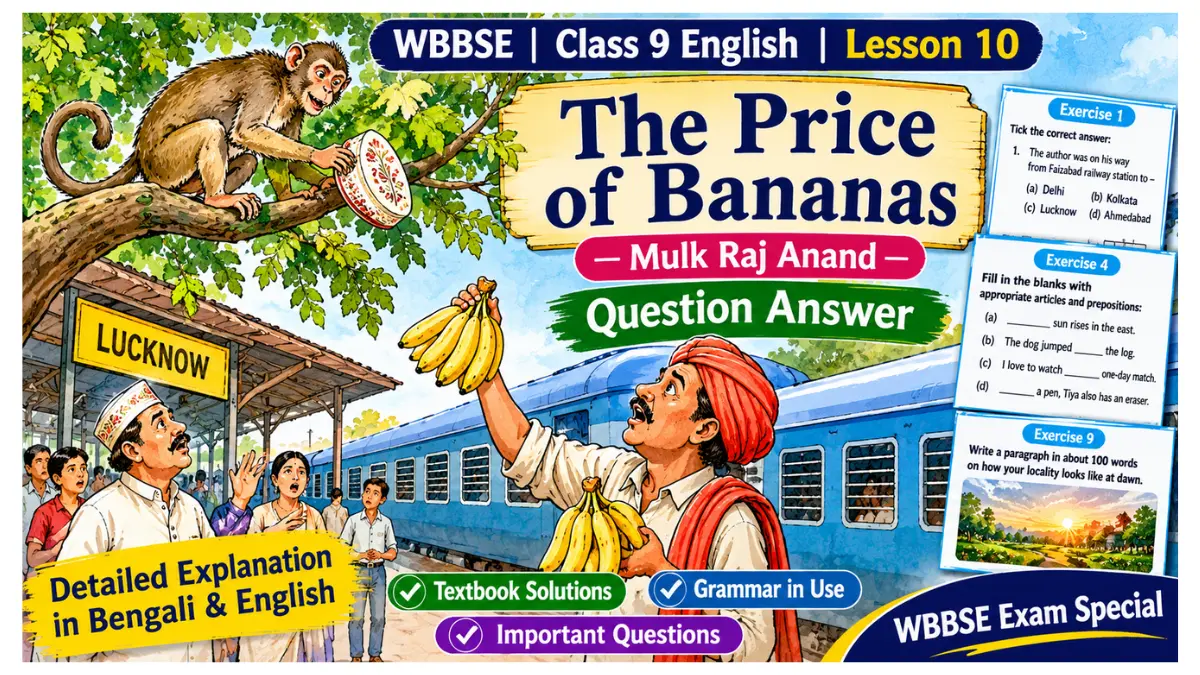
তুমি কি WBBSE নবম শ্রেণির ইংরেজি দশম পাঠ The Price of Bananas – Class 9 Question Answer খুঁজছ? Mulk Raj Anand-এর এই গল্পে একটি মজার ঘটনার মাধ্যমে একটি বানর, Sethji নামের এক ব্যবসায়ী এবং এক দরিদ্র ফল বিক্রেতার কাহিনি তুলে ধরা হয়েছে। এখানে তুমি পাবে পাঠ্যবইয়ের সমস্ত Exercise-এর সমাধান, MCQ, সংক্ষিপ্ত প্রশ্নোত্তর, গুরুত্বপূর্ণ ৩ ও ৫ নম্বরের প্রশ্নোত্তর, চরিত্র বিশ্লেষণ, শব্দার্থ এবং Grammar-এর সমাধান।
এই সম্পূর্ণ Study Guide-টি WBBSE নবম শ্রেণির ইংরেজি পাঠ্যবই অনুসরণ করে তৈরি করা হয়েছে। পরীক্ষার প্রস্তুতির সুবিধার্থে প্রতিটি উত্তর সহজ, স্পষ্ট এবং শিক্ষার্থীবান্ধব ভাষায় উপস্থাপন করা হয়েছে।
The Price of Bananas – Bengali Summary (বাংলা সারাংশ)
মুলক রাজ আনন্দের লেখা The Price of Bananas গল্পে একটি রেলযাত্রার মজার ঘটনার মাধ্যমে মানুষের লোভ, স্বার্থপরতা এবং দরিদ্র মানুষের প্রতি ধনী ব্যক্তির অবহেলার ছবি তুলে ধরা হয়েছে।
গল্পের কথক ফৈজাবাদ থেকে লখনউ যাওয়ার পথে একটি ট্রেনে ভ্রমণ করছিলেন। পথে একটি স্টেশনে ট্রেন থামলে তিনি দেখতে পান, কয়েকজন যাত্রী জলের পাম্প থেকে মাটির কলসিতে জল ভরছেন। স্টেশনের পাশে নিম ও তেঁতুল গাছে কয়েকটি বাঁদর বসে ছিল। তারা যাত্রীদের জিনিসপত্র নিয়ে দুষ্টুমি করছিল। এমনকি একটি বাঁদর এক পুণ্যবান ব্যক্তির কোমরের কাপড়ও ছিনিয়ে নিয়েছিল।
এরপর একটি ধনী ব্যবসায়ী ট্রেনের কামরায় ওঠেন। তাঁর পরনে ছিল সাদা মসলিনের ধুতি, সুন্দর জামা এবং নকশা করা টুপি। তাঁর সঙ্গে ছিল একটি বড় স্টিলের ট্রাঙ্ক, কয়েকটি ছোট ঝুড়ি এবং একটি পিতলের জগ। তিনি নিজের জিনিসপত্র নিয়ে বেশ গর্বিত ছিলেন।
কিছুক্ষণ পর একটি বাঁদর ব্যবসায়ীটির মাথা থেকে নকশা করা টুপিটি ছিনিয়ে নিয়ে একটি উঁচু নিমগাছে উঠে যায়। ব্যবসায়ীটি খুব চিন্তিত হয়ে পড়েন এবং টুপিটি ফেরত পাওয়ার জন্য নানা চেষ্টা করতে থাকেন। কিন্তু বাঁদরটি গাছের ডালে বসে টুপিটি নিয়ে খেলা করতে থাকে।
Textual Questions and Answers
Let’s begin with the textbook questions and their answers.
Exercise 1: Multiple Choice Questions (MCQ)
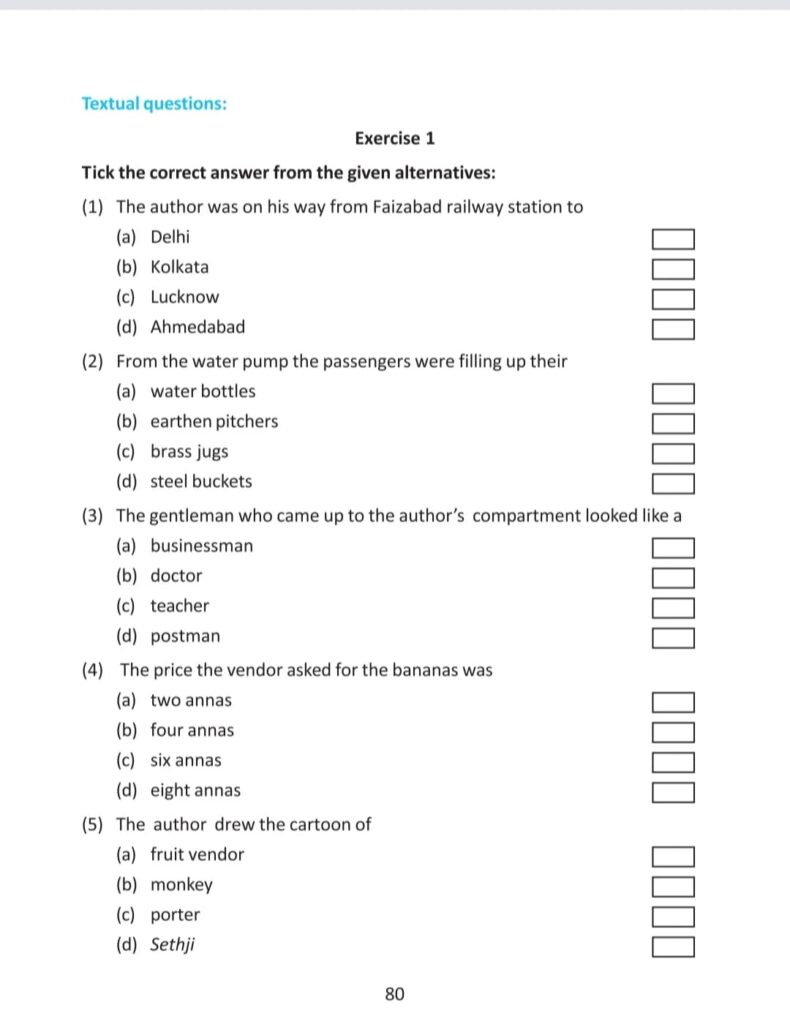
Choose the correct answer from the given alternatives.
1. The author was on his way from Faizabad railway station to —
(a) Delhi
(b) Kolkata
(c) Lucknow
(d) Ahmedabad
Answer: (c) Lucknow
বাংলা ব্যাখ্যা: লেখক ফৈজাবাদ রেলস্টেশন থেকে লখনউ যাওয়ার পথে ছিলেন।
2. From the water pump the passengers were filling up their —
(a) Water bottles
(b) Earthen pitchers
(c) Brass jugs
(d) Steel buckets
Answer: (b) Earthen pitchers
বাংলা ব্যাখ্যা: গরমের কারণে যাত্রীরা জলের পাম্প থেকে ছোট ছোট মাটির কলসিতে জল ভরছিলেন।
3. The gentleman who came up to the author’s compartment looked like a —
(a) Businessman
(b) Doctor
(c) Teacher
(d) Postman
Answer: (a) Businessman
বাংলা ব্যাখ্যা: লেখকের কামরায় আসা ভদ্রলোককে একজন ব্যবসায়ীর মতো দেখতে লাগছিল।
4. The price the vendor asked for the bananas was —
(a) Two annas
(b) Four annas
(c) Six annas
(d) Eight annas
Answer: (a) Two annas
বাংলা ব্যাখ্যা: কলা বিক্রেতা Sethji-র কাছে বানরের জন্য দেওয়া কলার দাম হিসেবে দুই আনা চেয়েছিল।
5. The author drew the cartoon of —
(a) Fruit vendor
(b) Monkey
(c) Porter
(d) Sethji
Answer: (d) Sethji
বাংলা ব্যাখ্যা: লেখক Sethji-র একটি ব্যঙ্গচিত্র এঁকেছিলেন। সেটি দেখে অন্য যাত্রীরা হাসছিলেন এবং Sethji অস্বস্তিতে পড়েছিলেন।
Exercise 2: Answer the following questions within fifteen words
1. Where did the young monkeys sit?
Answer: They sat on the boughs of neem and tamarind trees.
বাংলা অর্থ: ছোট বানরগুলি নিম ও তেঁতুল গাছের ডালে বসেছিল।
2. What did the monkey do to the loin cloth of the pious person?
Answer: The monkey threw the loin cloth down from the neem tree at the man’s feet.
বাংলা অর্থ: বানরটি নিমগাছ থেকে সাধু ব্যক্তির কোমরের কাপড়টি তাঁর পায়ের কাছে ছুড়ে ফেলে দিয়েছিল।
3. What did Sethji’s luggage include?
Answer: It included a big steel trunk, several small baskets and a brass jug.
বাংলা অর্থ: Sethji-র মালপত্রের মধ্যে একটি বড় স্টিলের ট্রাঙ্ক, কয়েকটি ছোট ঝুড়ি এবং একটি পিতলের জগ ছিল।
4. Why, according to the fruit vendor, were the monkeys disturbing the passengers?
Answer: The vendor said the monkeys were hungry, so they disturbed the passengers.
বাংলা অর্থ: ফল বিক্রেতার মতে, বানরগুলি ক্ষুধার্ত ছিল বলেই তারা যাত্রীদের বিরক্ত করছিল।
Exercise 3: Answer the following questions within twenty-five words
1. What was the businessman wearing?
Answer: He wore a white muslin dhoti, a delicate tunic and an embroidered cap.
বাংলা অর্থ: তিনি সাদা মসলিনের ধুতি, একটি সুন্দর জামা এবং নকশা করা টুপি পরেছিলেন।
2. What did the monkey do after accepting the fruit vendor’s bargain?
Answer: It took the bananas with its right hand and released the slightly crumpled cap with its left.
বাংলা অর্থ: বানরটি ডান হাতে কলাগুলি নিয়ে বাঁ হাত দিয়ে সামান্য কুঁচকে যাওয়া টুপিটি ছেড়ে দিয়েছিল।
3. How did the whole amusing episode end?
Answer: It ended with Sethji underpaying the vendor, while the passengers sympathised with him and the author drew Sethji’s cartoon.
বাংলা অর্থ: ঘটনাটির শেষে Sethji ফল বিক্রেতাকে প্রাপ্য টাকা না দিয়ে কম টাকা দিয়েছিলেন। যাত্রীরা বিক্রেতার প্রতি সহানুভূতি প্রকাশ করেছিলেন এবং লেখক Sethji-র ব্যঙ্গচিত্র এঁকেছিলেন।
Grammar in Use – Textbook Solutions
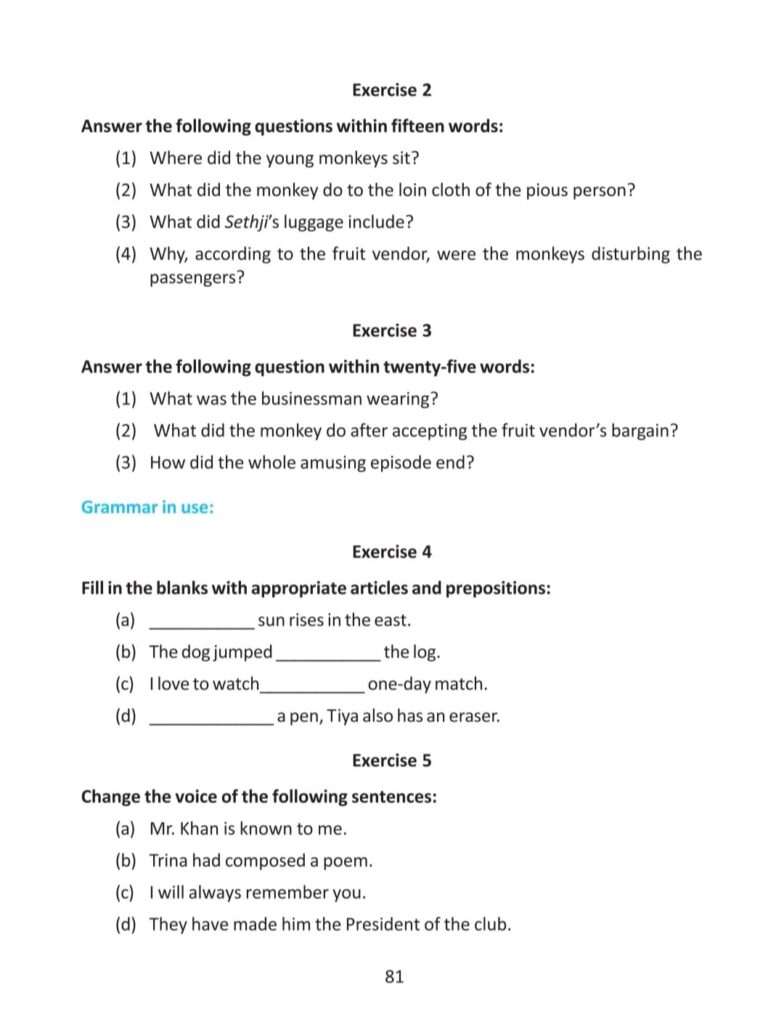
Exercise 4: Fill in the blanks with appropriate articles and prepositions
(a) ______ sun rises in the east.
Answer: The sun rises in the east.
Rule: We use the definite article ‘The’ before unique natural objects such as the sun, the moon and the earth.
বাংলা ব্যাখ্যা: সূর্য একটি অনন্য জ্যোতিষ্ক। তাই Sun-এর আগে The বসেছে।
(b) The dog jumped ______ the log.
Answer: The dog jumped over the log.
Rule: We use ‘over’ to indicate movement across or above something.
বাংলা ব্যাখ্যা: কুকুরটি গুঁড়িটির উপর দিয়ে লাফ দিয়েছিল। তাই এখানে ‘over’ বসেছে।
(c) I love to watch ______ one-day match.
Answer: I love to watch a one-day match.
Rule: We use ‘a’ before words beginning with a consonant sound. Although ‘one’ begins with the letter ‘o’, it starts with the consonant sound /w/.
বাংলা ব্যাখ্যা: One শব্দটি ‘ওয়া’ উচ্চারণ হয়। তাই এর আগে ‘a’ বসে, ‘an’ নয়।
(d) ______ a pen, Tiya also has an eraser.
Answer: Besides a pen, Tiya also has an eraser.
Rule: ‘Besides’ means ‘in addition to’ or ‘apart from’.
বাংলা ব্যাখ্যা: একটি কলম ছাড়াও টিয়ার একটি রবার আছে। এখানে অতিরিক্ত কিছু বোঝাতে Besides ব্যবহৃত হয়েছে।
Exercise 5: Change the voice of the following sentences
(a) Mr. Khan is known to me.
Answer: I know Mr. Khan.
Rule: Some passive constructions with ‘be known to’ can be changed into active voice using ‘know’.
বাংলা ব্যাখ্যা: এখানে ‘Mr. Khan’ কর্ম থেকে Active Voice-এর কর্মে পরিণত হয়েছে এবং ‘I’ কর্তা হয়েছে।
(b) Trina had composed a poem.
Answer: A poem had been composed by Trina.
Rule: Past Perfect Tense-এর Passive Voice structure:
Had + been + Past Participle (V3)
বাংলা ব্যাখ্যা: Past Perfect Tense-এর Active Voice-কে Passive Voice-এ পরিবর্তন করার সময় had-এর পরে been এবং verb-এর third form বসে।
(c) I will always remember you.
Answer: You will always be remembered by me.
Rule: Future Indefinite Tense-এর Passive Voice structure:
Will + be + Past Participle (V3)
বাংলা ব্যাখ্যা: Future Tense-এ Passive Voice তৈরি করতে will-এর পরে be এবং verb-এর third form বসে।
(d) They have made him the President of the club.
Answer: He has been made the President of the club by them.
Rule: Present Perfect Tense-এর Passive Voice structure:
Has/Have + been + Past Participle (V3)
বাংলা ব্যাখ্যা: এখানে ‘him’ পরিবর্তিত হয়ে ‘he’ হয়েছে এবং Present Perfect Tense-এর Passive Voice অনুযায়ী has been made ব্যবহৃত হয়েছে।
Exercise 6: Fill in the blanks with appropriate forms of the given verbs in brackets
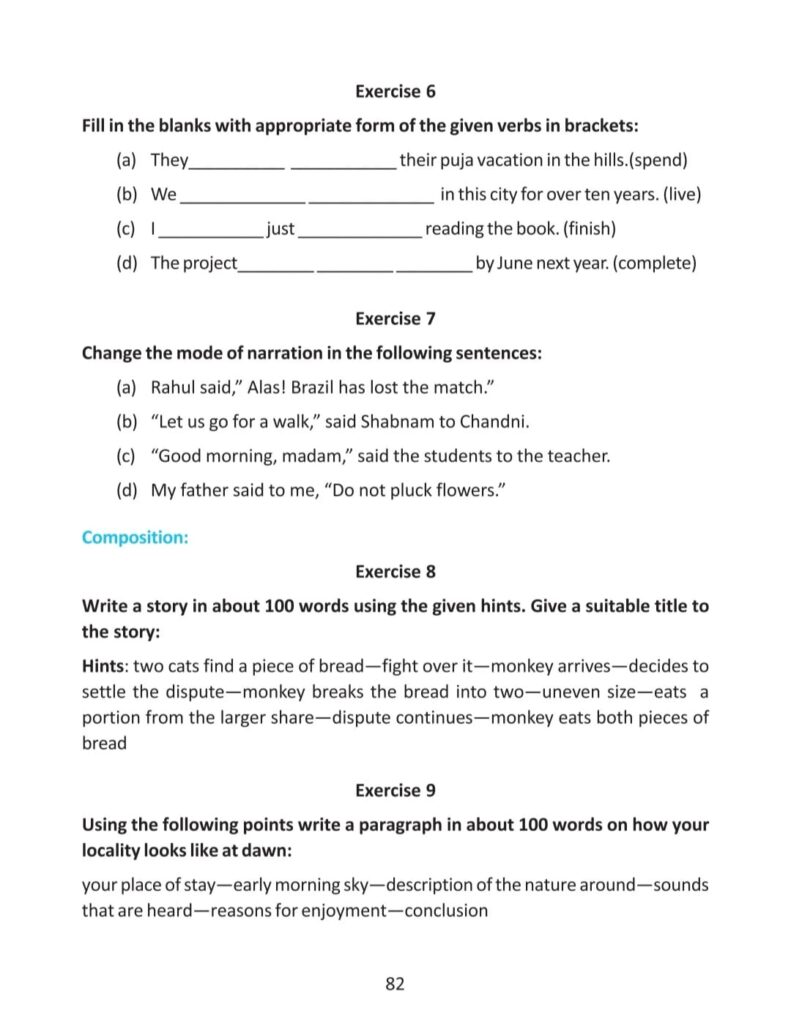
(a) They ______ ______ their puja vacation in the hills. (spend)
Answer: They are spending their puja vacation in the hills.
Explanation: Present Continuous Tense is used to describe an ongoing action.
Structure: Subject + am/is/are + V-ing.
বাংলা অর্থ: তারা পাহাড়ে তাদের পুজোর ছুটি কাটাচ্ছে।
(b) We ______ ______ in this city for over ten years. (live)
Answer: We have been living in this city for over ten years.
Explanation: Present Perfect Continuous Tense is used for an action that started in the past and continues up to the present.
Structure: Subject + have/has + been + V-ing.
বাংলা অর্থ: আমরা দশ বছরেরও বেশি সময় ধরে এই শহরে বসবাস করছি।
(c) I ______ just ______ reading the book. (finish)
Answer: I have just finished reading the book.
Explanation: Present Perfect Tense is used to describe a recently completed action.
Structure: Subject + have/has + V3.
বাংলা অর্থ: আমি এইমাত্র বইটি পড়া শেষ করেছি।
(d) The project ______ ______ ______ by June next year. (complete)
Answer: The project will have been completed by June next year.
Explanation: Future Perfect Passive Voice indicates that an action will be completed before a specified time in the future.
Structure: Subject + will have been + V3.
বাংলা অর্থ: আগামী বছরের জুন মাসের মধ্যে প্রকল্পটি সম্পন্ন হয়ে যাবে।
Exercise 7: Change the mode of narration in the following sentences
(a) Rahul said, “Alas! Brazil has lost the match.”
Answer: Rahul exclaimed with sorrow that Brazil had lost the match.
Explanation:
- ‘Alas’ changes into ‘exclaimed with sorrow’.
- Present Perfect Tense changes into Past Perfect Tense.
- ‘That’ is used as a conjunction.
বাংলা ব্যাখ্যা: দুঃখ প্রকাশক ‘Alas’ পরিবর্তিত হয়ে ‘exclaimed with sorrow’ হয়েছে।
(b) “Let us go for a walk,” said Shabnam to Chandni.
Answer: Shabnam suggested to Chandni that they should go for a walk.
Explanation:
- ‘Let us’ expressing a proposal changes into ‘suggested’.
- ‘That’ is used to introduce the reported clause.
- ‘We’ changes into ‘they’ according to the reporting subject.
বাংলা ব্যাখ্যা: একসঙ্গে কিছু করার প্রস্তাব বোঝাতে ‘Let us’ থাকলে Indirect Speech-এ suggested ব্যবহার করা যায়।
(c) “Good morning, madam,” said the students to the teacher.
Answer: The students wished their teacher good morning.
Explanation:
- A greeting is generally reported using ‘wished’.
- The direct address ‘madam’ is adjusted according to the sentence.
বাংলা ব্যাখ্যা: কাউকে শুভেচ্ছা জানানো বোঝাতে Indirect Speech-এ wished ব্যবহার করা হয়।
(d) My father said to me, “Do not pluck flowers.”
Answer: My father advised me not to pluck flowers.
Explanation:
- Negative imperative sentences generally change into ‘not to + verb’.
- ‘Said to’ changes into ‘advised’ when advice is expressed.
বাংলা ব্যাখ্যা: নিষেধ বা উপদেশ বোঝানো Negative Imperative Sentence-এ ‘not to’ ব্যবহার করা হয়।
Composition – Textbook Solutions
Exercise 8: Story Writing
Question: Write a story in about 100 words using the given hints. Give a suitable title to the story.
Hints: Two cats find a piece of bread – fight over it – monkey arrives – decides to settle the dispute – monkey breaks the bread into two – uneven size – eats a portion from the larger share – dispute continues – monkey eats both pieces of bread.
The Two Cats and the Monkey
Once two cats found a piece of bread. Both wanted to eat it, so they began to quarrel. A monkey came there and offered to settle their dispute. He broke the bread into two unequal pieces. Then he ate a little from the larger piece to make them equal. But the other piece became larger. The monkey continued eating from one piece and then the other. The cats kept arguing while the monkey ate both pieces of bread. Finally, nothing was left for the cats. They realised their mistake and regretted trusting the greedy monkey.
Moral: When two people quarrel, a third person may take advantage of them.
বাংলা সারমর্ম: দুটি বিড়াল একটি রুটির টুকরো নিয়ে ঝগড়া করছিল। একটি বানর তাদের বিবাদ মেটানোর অজুহাতে রুটিটি অসমান দুই ভাগে ভাগ করে। সমান করার নামে সে দুই ভাগ থেকেই খেতে থাকে এবং শেষ পর্যন্ত পুরো রুটিটাই খেয়ে ফেলে। বিড়াল দুটি কিছুই পায় না।
Exercise 9: Paragraph Writing
Question: Using the following points, write a paragraph in about 100 words on how your locality looks like at dawn.
Points: Your place of stay – early morning sky – description of nature around – sounds that are heard – reasons for enjoyment – conclusion.
My Locality at Dawn
I live in a small and peaceful locality. At dawn, the eastern sky looks beautiful with the golden rays of the rising sun. The fresh morning air and the green trees make the surroundings pleasant. Dewdrops shine like pearls on the blades of grass. Birds chirp sweetly in the trees, while the distant sound of temple bells creates a peaceful atmosphere. Some people go for morning walks, and others practise yoga. The streets remain quiet and clean. I enjoy the beauty of nature and the fresh air. Indeed, the morning scene of my locality is charming and refreshing.
বাংলা অর্থ: আমি একটি ছোট ও শান্তিপূর্ণ এলাকায় বাস করি। ভোরবেলায় পূর্ব আকাশ উদীয়মান সূর্যের সোনালি আলোয় সুন্দর হয়ে ওঠে। সতেজ বাতাস, সবুজ গাছপালা এবং পাখির মিষ্টি ডাক চারপাশকে মনোরম করে তোলে। শিশিরবিন্দুগুলি ঘাসের ওপর মুক্তোর মতো ঝলমল করে। আমার এলাকার ভোরের পরিবেশ সত্যিই মনোরম ও সতেজ।
Additional Important Questions and Answers
The Price of Bananas | Mulk Raj Anand | Class 9 English | WBBSE | Lesson 10
এই অংশে Textbook Exercises-এর প্রশ্নগুলির বাইরে আরও কিছু গুরুত্বপূর্ণ প্রশ্নোত্তর । পরীক্ষার প্রস্তুতির জন্য 1, 2, 3 এবং 5 নম্বরের প্রশ্নগুলি অনুশীলন করো।
A. Very Short Answer Type Questions (1 Mark)
1. Where was the author sitting while waiting for the train?
Ans. The author was sitting on a bench watching the monkeys on the platform.
2. What were the monkeys collecting from the platform?
Ans. They were collecting half-sucked mango stones and the remains of food.
3. Name the two kinds of trees mentioned in the story.
Ans. Neem and tamarind trees.
4. What was the pious person doing under the water pump?
Ans. He was taking a bath under the water pump.
5. What did the monkey snatch from the businessman?
Ans. The monkey snatched his fine embroidered cap.
6. Who offered to rescue the businessman’s cap?
Ans. A fruit vendor offered to rescue the businessman’s cap.
7. How many bananas did the vendor use to attract the monkey?
Ans. The vendor used a couple of bananas to attract the monkey.
8. What did the monkey hold in its left hand after accepting the bargain?
Ans. It held the businessman’s embroidered cap in its left hand.
9. How much money did the businessman give to the fruit vendor?
Ans. He gave the fruit vendor one anna.
10. What did the author draw at the end of the story?
Ans. The author drew a cartoon of Sethji.
B. Short Answer Type Questions (2 Marks)
1. Why was the author amused by the monkeys on the platform?
Ans. The monkeys were doing amusing things on the platform. One of them even snatched a pious man’s loin cloth, causing general amusement among the passengers.
2. Describe the behaviour of the businessman after losing his cap.
Ans. The businessman became extremely confused and angry. His face was covered with perspiration as he shouted at the monkey and tried to get his cap back.
3. Why did the monkey climb down cautiously towards the fruit vendor?
Ans. The fruit vendor attracted the monkey by dangling bananas. The monkey gradually came down because it was tempted by the bananas.
4. Why did the passengers praise the fruit vendor?
Ans. The fruit vendor cleverly persuaded the monkey to exchange the businessman’s cap for bananas. The passengers praised him for his successful effort.
5. Why did the fruit vendor ask Sethji for two annas?
Ans. The fruit vendor asked for two annas as the price of the bananas he had offered to the monkey to rescue Sethji’s cap.
6. Why did Sethji refuse to pay the fruit vendor fairly?
Ans. Sethji was selfish and ungrateful. Although the fruit vendor had rescued his cap, he refused to pay him the requested amount.
7. What did the fruit vendor do when Sethji refused to pay him?
Ans. The fruit vendor pleaded with Sethji for payment and ran alongside the moving train, holding on to its footstep.
8. Why did the passengers feel sympathy for the fruit vendor?
Ans. The passengers felt that the poor fruit vendor had been treated unjustly by the rich businessman despite his generous help.
C. Descriptive Answer Type Questions (3 Marks)
1. Describe how the fruit vendor rescued the businessman’s cap.
Ans. The fruit vendor offered to rescue the businessman’s embroidered cap from the monkey. He dangled two bananas before the monkey and gently coaxed it to come down. The monkey gradually approached him and finally accepted the bargain. It took the bananas with its right hand and released the cap with its left hand. Thus, the fruit vendor successfully rescued the cap.
2. How did Sethji behave towards the fruit vendor after getting back his cap?
Ans. Sethji behaved very rudely and selfishly towards the fruit vendor. Although the vendor had successfully rescued his valuable cap, Sethji refused to pay him two annas. He gave him only one anna and ignored his repeated requests for fair payment. Even when the vendor ran alongside the moving train, Sethji showed no sympathy and turned his head away.
3. Explain the significance of the title ‘The Price of Bananas’.
Ans. The title ‘The Price of Bananas’ is significant because bananas play an important role in the central incident of the story. The fruit vendor uses bananas to persuade the monkey to return Sethji’s embroidered cap. After successfully rescuing the cap, the vendor asks Sethji for two annas as the price of the bananas. However, Sethji refuses to pay him fairly. Thus, the title highlights both the importance of bananas in the incident and the businessman’s injustice towards the poor vendor.
4. Why did the author consider the ending of the incident bitter rather than amusing?
Ans. At first, the incident seemed amusing because a monkey had snatched the businessman’s cap and the fruit vendor cleverly rescued it. However, the ending revealed Sethji’s selfish and ungrateful nature. He refused to pay the poor vendor fairly despite receiving his help. The author and the other passengers felt sympathy for the vendor. Therefore, the amusing incident ended with a bitter feeling of injustice.
D. Long Answer Type Questions (5 Marks)
1. Give an account of the incident involving the monkey, Sethji and the fruit vendor.
Ans.
The incident took place at a railway station when the author was waiting for a train to Lucknow. A businessman, known as Sethji, arrived at the compartment with his luggage. Suddenly, a monkey jumped down from the top of the compartment and snatched his embroidered cap. Sethji became furious and tried to frighten the monkey, but it climbed higher up a neem tree.
A fruit vendor offered to rescue the cap. He attracted the monkey by dangling two bananas before it. The monkey gradually came down and finally accepted the bargain. It took the bananas and released the cap.
The passengers praised the vendor for his cleverness. However, when he asked Sethji for two annas as the price of the bananas, Sethji refused to pay him fairly. He gave him only one anna. The poor vendor pleaded for justice, but Sethji ignored him. The train started moving, and the disappointed vendor finally dropped off. The incident exposed Sethji’s selfish and ungrateful nature.
2. Sketch the character of Sethji in the story ‘The Price of Bananas’.
Ans.
Sethji is portrayed as a rich, proud, selfish and ungrateful businessman in the story. He wore a white muslin dhoti, a delicate tunic and an embroidered cap. He had a big steel trunk, several small baskets and a brass jug as his luggage.
When a monkey snatched his cap, he became extremely angry and confused. He shouted at the monkey but could not recover his cap. A poor fruit vendor came forward and cleverly rescued it by offering bananas to the monkey.
However, Sethji failed to show gratitude towards the vendor. Instead of paying the requested two annas, he gave him only one anna. When the vendor protested, Sethji insulted him and turned away. Even when the vendor ran alongside the moving train, Sethji refused to listen to him.
His behaviour reveals his arrogance, selfishness and lack of sympathy for poor people. Through this character, Mulk Raj Anand criticises the unjust attitude of the rich towards the poor.
3. Describe the character of the fruit vendor.
Ans.
The fruit vendor is one of the most sympathetic and important characters in the story. He is a poor but kind-hearted, clever and generous man. When Sethji’s embroidered cap was snatched by a monkey, the vendor voluntarily offered to rescue it.
He used his intelligence and patience to solve the problem. By dangling two bananas before the monkey, he successfully persuaded it to exchange the cap for the fruits. His clever action pleased all the passengers.
However, Sethji behaved unfairly towards him. Although the vendor had saved his valuable cap, Sethji refused to pay the agreed price of two annas. The vendor repeatedly pleaded for his rightful payment and even ran alongside the moving train.
His helpless condition moved the author and the other passengers. Through the fruit vendor, the author highlights the dignity of honest labour and the suffering of poor people at the hands of the rich.
E. Important Theme-Based Questions
1. What message does Mulk Raj Anand convey through the story?
Ans. Mulk Raj Anand conveys that wealth does not necessarily make a person generous or noble. Through Sethji’s behaviour towards the poor fruit vendor, the author exposes social injustice, selfishness and the exploitation of the poor by the rich.
2. How does the story present the contrast between the rich and the poor?
Ans. The story presents Sethji as a wealthy but selfish businessman and the fruit vendor as a poor but generous person. Although the vendor helps Sethji, he is denied fair payment. This contrast exposes the unequal treatment of poor people in society.
3. Why is the cartoon of Sethji important in the story?
Ans. The cartoon of Sethji is important because it expresses the author’s disapproval of his selfish and unjust behaviour. The passengers laugh at the cartoon, making Sethji increasingly uncomfortable.
F. Important Vocabulary from the Story
| Word | Meaning |
|---|---|
| Flickering | Moving quickly and lightly |
| Frisking | Jumping and playing energetically |
| Loin cloth | A piece of cloth worn around the waist |
| Perspiration | Sweat |
| Piteous | Deserving pity |
| Coaxed | Persuaded gently |
| Crumpled | Crushed or wrinkled |
| Impudence | Rude or disrespectful behaviour |
| Grimy | Dirty |
| Scowled | Looked angrily |
| Grievance | A feeling of being treated unfairly |
| Humble | Modest; not proud |
Frequently Asked Questions (FAQ)
Q1. Who is the author of The Price of Bananas?
The author of The Price of Bananas is Mulk Raj Anand (1905–2004), a famous Indian writer.
1. What is the name of Lesson 10 in WBBSE Class 9 English?
The name of Lesson 10 in the WBBSE Class 9 English textbook Bliss is The Price of Bananas.
2. Who is the author of The Price of Bananas?
The story The Price of Bananas was written by the famous Indian writer Mulk Raj Anand.
3. Where was the author travelling from and to?
The author was travelling from Faizabad railway station towards Lucknow.
4. What did the monkeys do to the pious person?
The monkeys snatched the loincloth of a pious person and threw it down.
5. What did the monkey snatch from Sethji?
The monkey snatched Sethji’s embroidered cap and climbed up a neem tree with it.
6. How did the fruit vendor help Sethji get back his cap?
The fruit vendor tempted the monkey with two bananas. The monkey took the bananas and released Sethji’s cap.
7. How much money did the fruit vendor ask for the bananas?
The fruit vendor initially asked for two annas for the bananas.
8. Why did the fruit vendor run alongside the train?
The fruit vendor ran alongside the moving train because Sethji refused to pay him the full price of the bananas.
আরও পড়ুন –
